



When the late Jürgen Habermas lamented the New Obscurity in 19851, we could diagnose the exact opposite today: a level of intellectual conformity that might evoke memories of German history’s darkest era. However, the reasons for this new, surprisingly clear understanding are not at all obvious. If you only consider the symptoms, you could speak—depending on your perspective—of a narrowing of the range of opinion, an infantilization of political discourse, or the Clickbait logic—but this only focuses on the symptoms. Talk of the Attention Economy generously overlooks that Money’s primordial function actually lies in its suitability as a means of value storage. In contrast, the uncomfortable truth is that, in the age of clickbait, we’re not dealing with preservation but with shrinking attention spans (as our former Chancellor demonstrated when she promised to govern by sight). It’s no coincidence that the media coups of the past have turned out to be strategic errors; today, with considerable delay, we must conclude that the groundbreaking decisions of that era stemmed from political short-sightedness, if not from base motives altogether. While this has previously led me to see it as a Sham Economy illusion – a kind of Limbo Economy – ultimately, it comes down to the sinister conclusion that the Beautiful, the True, and the Good are things of the past, since Art has become kitsch, Truth has turned into bullshit, and Ethics have shifted into moral grandstanding.2 If you ask an intellectual how a Society that bandies about noble concepts like creativity, diversity, and human dignity could have succumbed to utter stupidity, he will blame social media—or, à la Yanis Varoufakis, cite a new techno-feudalism. There is no doubt that social media (which will also play a major role in what follows) has contributed to the deterioration of discourse; however, it’s far too simplistic to blame technology (or the tech companies behind it) for this alone. For my part, back in the early 1990s, I already observed in public broadcasters how the Attention Economy was taking hold—and how the fact that the Nuremberg Society for Consumer Research had been a Nazi invention was conveniently swept under the rug. What did Goebbels say in a lecture for the Westdeutscher Rundfunk? 90% should be entertainment; 10% political propaganda is entirely sufficient.

The starting point of my disquiet was an incident in 2015, soon after I finished writing an essay on Jeremy Bentham, aptly titled The Master of All Selfies3. In fact, studying Bentham—who went down in history as the inventor of the infamous Panopticon—was enlightening insofar as he’d had the idea of immortalizing himself as an Auto-Icon. For this reason, he had instructed his physician friend to have his body stuffed using a Maori technique, with the unfortunate side effect that his head, having become a shrunken head, was disfigured beyond recognition, necessitating its replacement with a wax replica.


And because my friend, the cosmetic—no, the plastic surgeon—had told me that quite a few people undergo cosmetic surgery to look like their own profile picture since the Internet’s been flooded with Duck Faces and other beauty filters, it was clear that what had once been consigned to a digital alternate world as Second Life had long since come to dominate reality. And it was into this train of thought that the unfortunate case of Sir Tim Hunt, a Nobel laureate, burst—a storm of indignation suddenly erupting out of the blue against him.

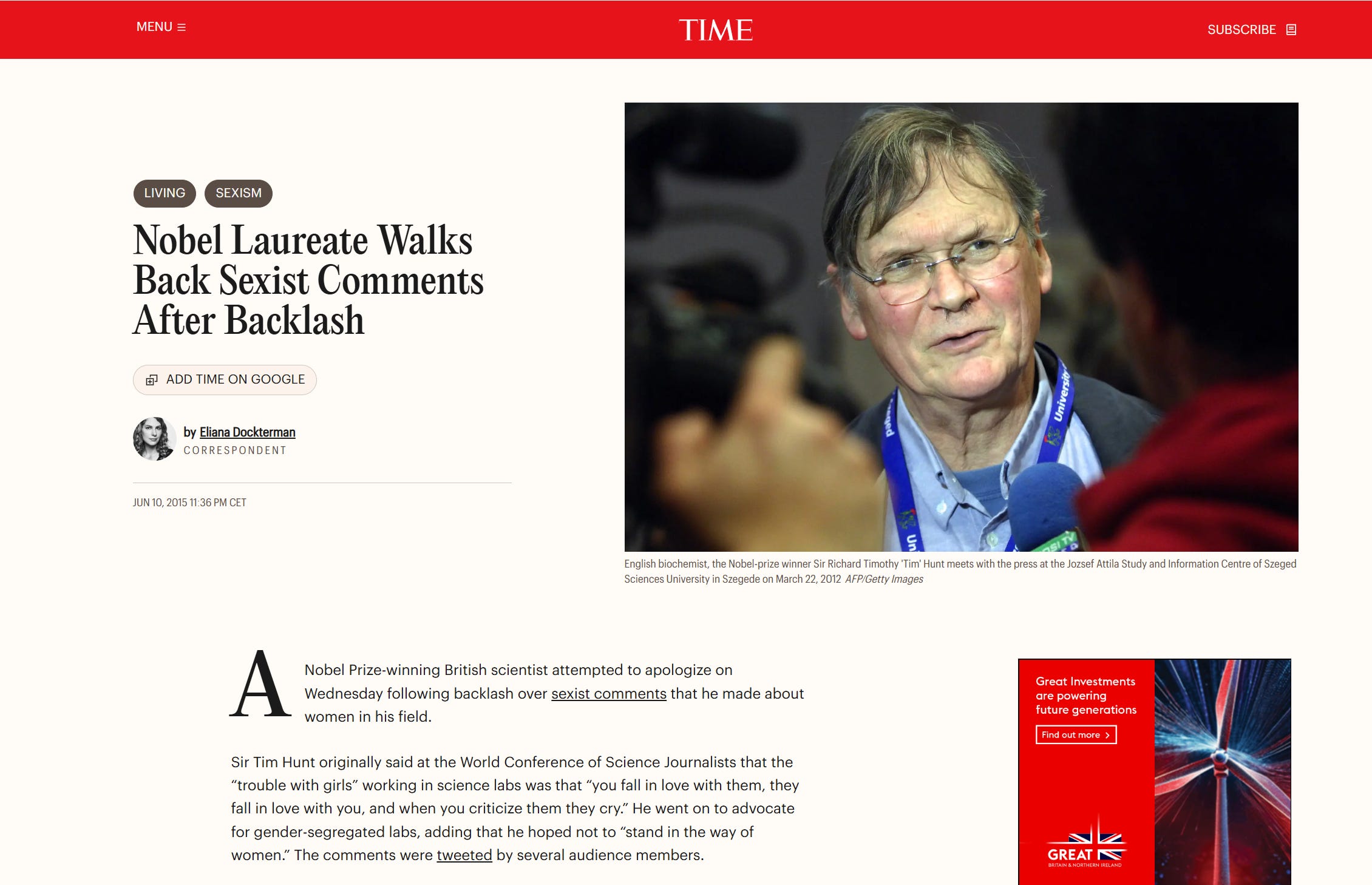
So, what had happened? The 72-year-old Nobel laureate had been invited to Seoul to lend some significance—no, more than that: to bring scientific gravitas—to a conference on the role of women in science. There, after being asked to give a short, impromptu speech, he introduced himself to his predominantly female audience with these self-deprecating words:
»It’s strange that such a chauvinist monster like me has been asked to speak to women scientists. Let me tell you about my trouble with girls. Three things happen when they are in the lab: you fall in love with them, they fall in love with you, and when you criticise them they cry. Perhaps we should make separate labs for boys and girls? Now, seriously, I’m impressed by the economic development of Korea. And women scientists played, without a doubt, an important role in it. Science needs women, and you should do science, despite all the obstacles, and despite monsters like me.«
As expected, the audience responded with loud laughter to this humorous remark. However, in addition to the Korean guests, Connie St. Louis, a British science journalist, was also sitting in the audience, and spotting an opportunity, she set out to expose a Nobel laureate as a sexist. She seized on Hunt’s remark and tweeted in a tone of sincere outrage that »sexist Tim Hunt« had ruined the event with his comment that gender segregation should be reintroduced in laboratories. When another Twitter user asked whether the lecture had been recorded, another conference attendee confirmed the journalist’s accusation. Although it had been secretly agreed upon in advance, this set the stage for the public. What followed was a firestorm where first the Twitterati, then the International media, competed to outdo each other in their outrage at the alleged sexist. Even before Sir Hunt set foot on English soil again, he had lost his professorship at University College London, his honorary seat in the Royal Society, and his position at the European Research Council. Even the Korean organizers felt compelled to distance themselves from his appearance afterward. His claim that he’d only meant it as a joke was interpreted as an admission of misconduct, as was a public apology delivered through tears. Not only was the accusation based on a severe misrepresentation of the incident, but the accuser, Connie St. Louis, was also a rather questionable individual. While, as a Black woman, she might have felt particularly entitled to claim victimhood, the biography she shared on her website was full of inaccurate and grossly misleading information. So it remained up to the conference participants to address the difference between personal memory and media coverage. As objections mounted, Connie St. Louis doubled down, asserting that it wasn’t just her alone—the entire room had reacted to Hunt’s remarks with deadly silence. Although more and more strange details about the science journalist’s Pseudologies emerged, it was only when a recording surfaced showing Hunt among a cheering crowd that the story collapsed.4 But by then, Hunt had long since become a non-person. More important than the fate of individuals, however, is what the affair reveals about a society that permits such things to happen. While the media Witch Hunt may bring to mind the Communist persecutions of the McCarthy era, this parallel also underscores important differences.5 Because while the early Cold War focused on the interests of the State, the Hunt affair is all about Identity Politics. And since any sexist, no matter his merits, must never be allowed to play any role, the little Brothers and Sisters were quick to declare Sir Tim Hunt an Unperson, despite the actual circumstances.
To convey the tone of even a bourgeois public that considers itself liberal-minded, we offer the following commentary that Ariane Bemmer, the opinion editor for the Tagesspiegel, offered on the matter:
Old chauvinism piped up loudly once again — but wham — it got a good knock on the noggin, so things should be quiet again for a while. And rightly so. Old chauvinism in this case is the 72-year-old Nobel laureate Tim Hunt. He made a remark at a conference in Seoul that he — as he later tacked on — thought was funny. Since then, he’s been free to tend to his quinces in his lovely garden in the county of Hertfordshire, north of London.6
What makes Sir Tim Hunt’s case remarkable is the utter disproportion: the circumstances of a small, scattered group of individuals (nowadays referred to as activists, though perhaps more aptly understood as a coalition of free radicals) managing to establish a narrative that the entire public wholeheartedly embraced—and this despite the fact that the lecture (since it had been recorded) could have easily been watched on YouTube. The fact that newspapers and television stations skipped their research and instead launched into a Postmodern Witch Hunt could—albeit with some stretch of the imagination—be attributed to Clickbait logic. But the institutions involved should have exercised their responsibility to conduct due diligence and, after examining the facts, have defended the scholar, rather than distancing themselves from him—even going so far as to demand an apology from him. This can only be seen as a form of institutional cowardice, a conformism that casts doubt on the integrity of all involved. More concerning, however, is that the »sexism scandal« was based solely on the complete denial—no, the inversion—of reality. If Roland Barthes once aptly said, »Desire writes the text,« then we might conclude that the underlying desire lay in the humiliation, indeed, in the symbolic annihilation of an old white man. This outbreak of collective psychopathology—what I have called Sociose—is nonetheless remarkable, for here we are confronted with a resentment that only finds its satisfaction in conjuring up a Monster [Ungeheuer].
This brings us to the second case, taking us back to 2023—specifically to the day when Hamas carried out the October 7th Pogrom.

If the case of this young woman, who was active in the pro-Hamas camp on the Stanford campus, is to be recounted here, it isn’t to use an ad hominem argument to condemn her folly (which, moreover—and this is to her greatest credit—she distanced herself from her errors in the interview), but because hers is an exemplary story, a conversation that prompts reflection on group and mob behavior.
When asked by the interviewer how she would describe herself, the young woman said she’s an activist who has always been politically committed to defending the disenfranchised worldwide. While most of her support before October 7th had been limited to occasional Free Palestine posts, on October 7th, she noticed countless Palestinian flags appearing in her live feed. This led her to assume that the Gaza Strip had been attacked by the Israeli army and that the dead mentioned must undoubtedly be soldiers of the Israeli armed forces. She realized the gravity of the situation when flyers appeared on campus the following day, calling for participation in community discussions—a call she heeded immediately. The speakers shared their views, saying that this conflict had been simmering for a long time—actually, since the founding of the Israeli State—highlighting the importance of taking a strong stand. The activist certainly didn’t need to be told this because she had long known that if you didn’t pay this social currency, you could expect intense peer pressure (it felt critical to voice your opinion early and as often as possible to show what it means to be a true ally). In fact, anyone who didn’t conform to this social currency was seen as an opponent—no, worse, as someone contributing to genocide. Regarding the events themselves, the young woman was firmly convinced that this was genocide perpetrated by a criminal apartheid system—and because she saw in it a reenactment of American racial segregation where Hamas played the role of a heroic Black Panther movement, she interpreted her own resistance to the Israeli actions as a struggle against the injustices faced by her ancestors. Anyone who didn’t share this worldview was a Zionist paid by the American Israel Public Affairs Committee (AIPAC). Because interacting with such paid lackeys was seen as unhelpful and there was also the risk of being filmed or recorded during such a discussion, the very idea of having any conversation lay beyond the horizon of thought. Consequently, it was crucial (since »Zionist is a dirty word«) to avoid such contamination—along with any critical or even hesitant questioning. The young woman was well aware that the revered Hamas had no qualms about resorting to violence, but since the end justifies the means, these atrocities had to be viewed within a broader context. Or, as the slogan that overshadowed all other questions put it: Resistance is justified when Palestine is occupied. It was after she’d proven her loyalty and commitment to the cause that she began having her first doubts when, in June 2024, she witnessed her comrades from the Faculty for Justice in Palestine (FSJP) storm the faculty offices, causing significant damage and smearing the walls with graffiti that read, depending on the instance: »Pigs taste best dead« or »Death 2 Israel.«


As a result of this irritation, which was also her first tentative stepping away from the group, the young woman accepted an invitation to visit an exhibition in Los Angeles in October 2024—a good year after the pogrom. Although she’d wisely kept this decision secret from her like-minded peers, it was by no means a sign of a shift in her beliefs. On the contrary, until she entered the exhibition halls, she remained convinced that the exhibition organizers, the producers of the Nova Music Festival would present her with nothing but Israeli propaganda material. In a way, this expectation is a mystery, if not an outright absurdity. Up until the moment she entered the exhibition halls, she hadn’t even seen any of the Hamas videos showing the Nova Music Festival attendees running for their lives—let alone had any of her comrades posted such footage to their shared livestreaming. And so, the very first images were enough to dispel the long-held narrative that Hamas and Israeli soldiers had engaged in a firefight. When she saw young people her own age, who only wanted to attend a music festival, being slaughtered by Hamas’s henchmen, that the attackers were even gloating over their victims’ suffering, she realized she had been living within a false construct for an entire year—that her unwavering certainties were nothing more than a result of groupthink in a closed world disconnected from reality. And very gradually, working through this carefully cultivated ignorance, she became aware of all the omissions the activists were guilty of. For instance, she hadn’t even known that the Israelis had withdrawn from Gaza as early as 2005, meaning that it was by no means an occupied territory. She was even more astonished when, during a visit to Israel, she realized that Israel is home not only to Jews but also to Arabs, Druze, and Bedouins—and that it is by no means an apartheid state. Naturally, the question arises: what are the consequences of such a learning process? What happens when an individual distances herself from the group? The answer was as simple as it was brutal: it meant losing all her companions, even those she had considered her best friends. To make matters worse, the young woman suddenly found herself having to fend off racist accusations (Are you a monkey dancing to your master’s tune?).
As the young lady offered the following advice to her former comrades-in-arms (Put yourself in the shoes of the ones that are more opposite your political opinion), we now move into the heart of power—that is, where a Twitter king resides—and where, by order of the Mufti, his subordinates—no, the entire world—is ready to submit to his whims. The idea that an Apprentice might lull himself into absolute certainty is familiar to us, much like Goethe’s The Sorcerer’s Apprentice—just as the Stanford activist has enlightened us on how the information society offers ways to transform an overly complex reality into easily digestible bits of baby food. What is more remarkable, however, is that an entire cabinet participates in such compliance. As a result, no one objects when the boss criticizes his subordinates’ taste in shoes—and generously outfits them with shoes from Florsheim.
Now, as we all know, any criticism of style is an ad hominem attack. For my part, I wouldn’t just be outraged if such a package landed on my doorstep; I would—on principle alone—resolutely refuse to ever wear that pair of shoes. The fact that members of Trump’s cabinet have dutifully squeezed themselves into their master’s shoes testifies to a willingness to submit that’s highly disturbing—but it becomes even more grotesque when those concerned must struggle into shoes that are either much too big or so tight. As the Mufti says, »Seems to work out pretty well. Now they look all spiffy and nice!«
If we try to distill the essence of these three short stories, it becomes clear that we are dealing with a form of group behavior in which moral integrity, reality, and, ultimately, the dignity of the individual are sacrificed one after another. That an institution like the Royal Society, in order to maintain a spotless public image, sacrifices one of its members to a Twitter mob—and does so against its better judgment—leads to only one conclusion: that it is willing to sacrifice the truth to bullshit, a notion that casts academia in a truly bad light. Consequently, it isn’t surprising that a few years later, students at Stanford University, armed with keffiyehs, moral absolutism, and flimsy theories, find themselves caught up in a mindset that mocks all reality—and in which a mob mentality long since overcome is making a comeback. And when, in the end, the center of power bows to a showman who forces his subordinates—with their consent, no less—into a performance of self-degradation, this only testifies that the inner voice (what was once called the voice of conscience) has fallen victim to public image and opportunism. How can someone like J.D. Vance lecture European Nations on morality when he isn’t even capable of choosing his own shoes? Undoubtedly, social media plays a significant role here. For it allows a group to (paradoxically) shut itself off from any perception of the world—thereby casting a dark shadow, indeed, a veritable Monster, over the Information Society. In all of this, one might therefore detect a return to the Dark Ages—a Great Again! in which the True, Good, and Beautiful are replaced by bullshit, kitsch, and moral grandstanding. The compulsion to project an image makes it understandable that a Postmodern corset of virtue is imposed on institutions, that one speaks of genocide but actually has child murderers and well poisoners in mind—and that displays of power have replaced genuine politics. What lies behind this is what Max Horkheimer called erotic ressentiment—a sense of group belonging that derives pleasure from closed worldviews and demonizing the opponent; no, even more than that: it literally feeds on the Monsters it has conjured up from its imagination. Consequently, it is precisely this Monster’s lack of substance that allows group pressure to escalate to unbearable levels. From then on, everyone can be certain that the slightest dissent results in an expulsion from the group—and thus losing everything that had made the inner emptiness somewhat bearable.
Habermas, J. – The New Obscurity: The Crisis of the Welfare State and the Exhaustion of Utopian Energies, trans. P. Jacobs. Philosophy and Social Criticism, 1986 11 (2):1-18.
Burckhardt, M. – Scheinproduktion, Lettre International, LI 138, Fall 2022.
Burckhardt, M. – Der Meister Aller Selfies, Merkur, Issue 795, August 2015, vol. 6.
McCarthy’s activities, mind you, were initiated by a senator from Wisconsin, not by government action. Insofar as that, we’re dealing with a bottom-up exercise of power.


