


This lecture, which I gave at the Nuremberg Academy of Fine Arts in 2004, took place at a time when Facebook was just being founded, and no one had yet spoken of Social Media or anything remotely like it. Nevertheless, this realm was entirely familiar to me because, as an occasional visitor to a game developer forum, I’d witnessed the emergence of a new and decidedly unusual Social Sculpture (one that fueled both the higher and lower aspects of human nature—all the more so because the user could act safely behind a digital cloak of invisibility). Even more interesting was that growing familiarity with 3D simulation was sparking a revolution in space—which is why it became clear to me, even back then, that public space, too, would soon undergo a profound transformation.
Martin Burckhardt

Ladies and gentlemen,
I don’t know whether this will surprise you, but what I want to discuss falls under the motto: there is no public space unless you simulate it. Of course, we could respond to this rather shrill thesis by pointing to the realities at hand: there’s the space lying outside your doorstep where things like traffic regulations apply—or there’s the public sphere, which isn’t a space in the architectural sense, but rather a communicative dimension, such as when we feel involved in public debates about some nuisance or scandal. This dual character is, in itself, strange enough – after all, we’d be inclined to speak not of one but two public spaces. In one, you move around insofar as you are a physical being – habeas corpus; in the other, insofar as you’re participating in public debate, using your intellectual ability [nach Geisteskräften] – ad intra.
While it’s evident that this mind/body split gives us a wonderful opportunity to continue age-old debates – that’s not what I’m concerned with. Whether you take one side or the other, both are wrong. Instead, I would like to expose the driving forces underlying our perception of public space. Firstly, this means that public space shouldn’t be assumed to be a given but rather considered a product. In this sense, you can also interpret my thesis as holding that, logically, you’ve successfully staged a public space whenever you speak of it. Viewed historically, I would say that public space begins when the church no longer stands in the village: that is, in the 18th century. Allow me to roughly sketch out this history. In doing so, I will fast-forward through the future with an eye to the present. In this sense, the scenes you’re about to see are to illustrate the beginning thesis of my train of thought quickly. I will address some things directly, while others will be more like a trail of associations and video clips.
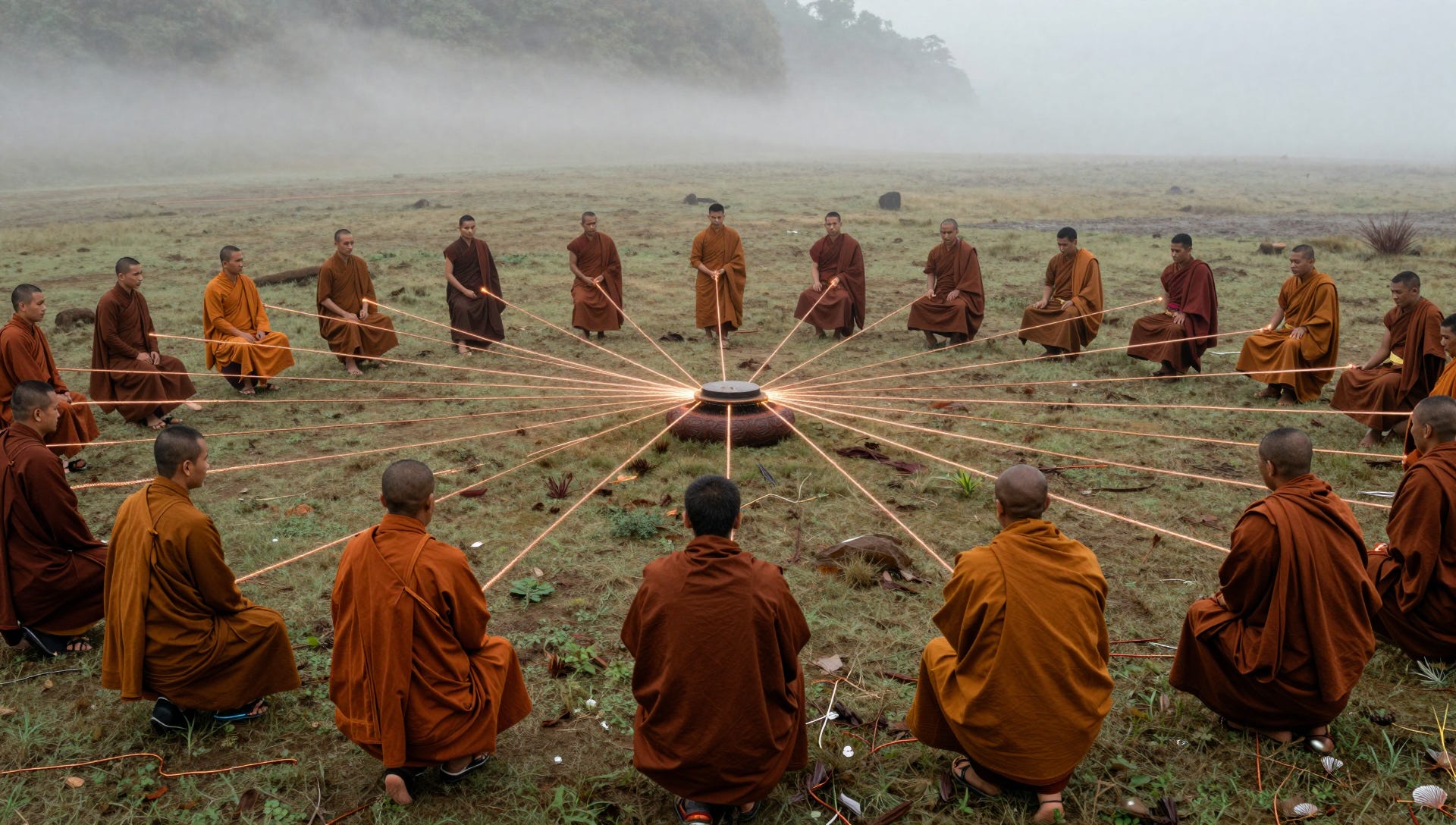
First scene: we are in the year 1746—shortly before Baumgarten wrote his Aesthetica: 200 monks have gathered here in a field in northern France and have connected themselves to each other with iron wire. One of them, Abbé Nollet, finally touches a strange object, and – what happens? They all twitch convulsively. This isn’t an occult event but a scientific experiment. The question is: How fast is electricity? Can you see a kind of phase shift? Can you see how the substance moves from one monk to the other? The answer is: No, electricity is so fast that it cannot be seen with the naked eye.
In this blink-of-an-eye, this Augenblick, I see a deep historical rift. With electricity, space becomes divided. If the monks previously lived in a landscape space within which every movement was visible, a telematic space has now been added, which, traveling at the speed of light, is thus absolutely incomprehensible. This abstract, invisible space is nevertheless real—something that the monks, who join together to form a large monad, a mass excitation, physically felt in their bodies. What we call mass is, first and foremost, a physical electrical mass. What’s more: we could speak of a human processor since the monastic aggregation, from a structural point of view, functions like a computer processor. In any case, in the Sign of this electric monk aggregate, a new world begins, having little to do with the stationary and the corporative—one that, in its longing for the dissolution of boundaries, is moving toward Global Citizenship. Space tilts into virtuality. It’s no longer the visible landscape but rather the channeled, interconnected, changing network – functioning as a control matrix: where signals are turned on and off, where traffic streams are directed, organized, and monitored. When we cross the street guided by a traffic light, we’re no longer moving in the old-fashioned, land-bound way but in the spatial-temporality of Modernity. However, this contextual speed—and this is what I wanted to get at—isn’t simply given but is structured, and it collapses when the electrical power fails.

Second scene: the Guillotine. When the guillotine was inaugurated on the Place de Grève in 1791, a large crowd of people flocked to see how this new killing machine, devised by Monsieur Guillotin to humanize death, worked. But when the guillotine blade falls, the crowd is outraged. And why? Because it happened in a blink-of-an-eye, no one saw anything—and so the rioting mob took to the streets, chanting that they want their good old gallows back. Considering that just a generation earlier, the King-assassin Damiens was drawn and quartered, you understand that something, well, drastic has happened here. You no longer see the struggling victim. You no longer see how the suffering body approaches its end. Death: reduced to a punctum, an abstracted before and after, an either/or that’s become abstract and digitalised—withdrawn from public view. Ultimately, with the electric chair, killing takes place without anyone in particular being responsible. Not only does death become abstract, but sovereignty also metamorphoses into an abstract Machine. It’s no coincidence that the death penalty is carried out in camera—hidden from public view behind closed doors. Here, the unfortunate victim is confronted with the abstract sovereignty that connects society into a large monad: the electric shock, the Battery.
Whenever watching Hitchcock’s famous Psycho scene, you never see the knife penetrating the woman’s body. Because we cannot see death in what we see, as the image forces itself upon us, it forces us to look. Hitchcock, you might say, lets us take a seat where the King and Executioner once sat—except we no longer carry out the execution ourselves, but suffer through it aesthetically, as spectators. In this multiperspectivity, we are simultaneously perpetrators, victims, and witnesses – but not really, only insofar as we are spectators. We kill abstractly, we suffer abstractly, and we watch abstractly. That means we no longer communicate at eye level, face-to-face, but through a third party—an interface. In fact, the scene’s center of power has shifted into the cutting room’s editing floor. As Hitchcock himself put it, it’s the mighty power of playing on the audience’s feelings like on an organ. What is this power’s technical basis? Its power isn’t based on what it shows, but on the way it does it. It is not the murderer and his deed that affect the audience’s emotions, but rather the knife, the director’s little guillotine, which channels the flow of perception, associates the two rooms and points of view, and edits them together into a space of perception. Power thus operates behind the scenes: it is the Director’s might and Director’s cut that guides your gaze. At this point, I’d speak in very general terms of a simulation technique, of a programming of the space of perception.
Modernity
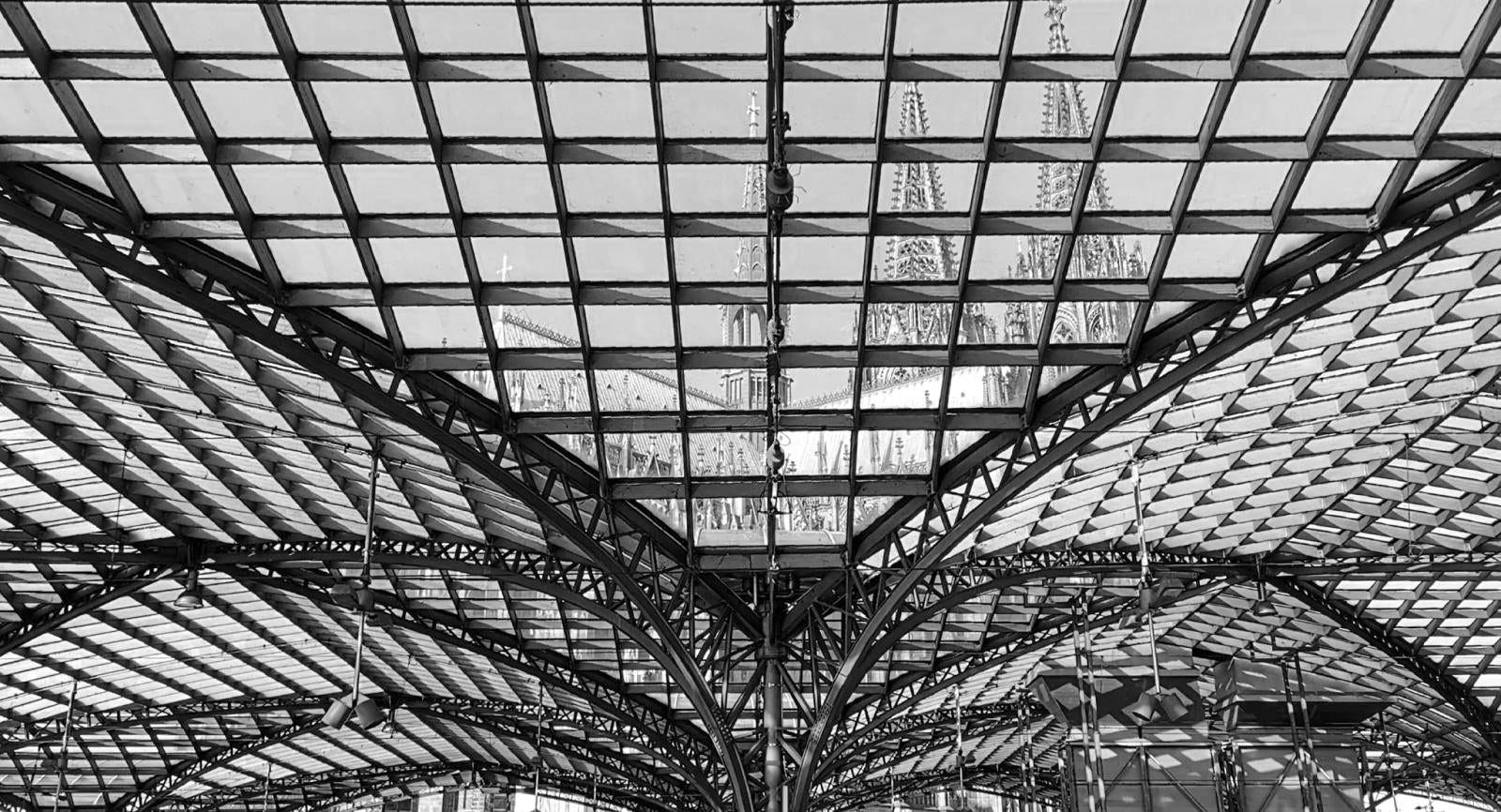
In telling Modernity’s story, it’d be appropriate to understand it as a form of occultation. Modernism falls behind itself—conceptually speaking, it doesn’t operate at the height of its own capabilities. Cast iron at its core, it presents itself as neo-Gothic. It appears solid, but is rapidly disintegrating. What is referred to as 19th century syncretism is, both architecturally and ideologically, a technique of deception. That which gives modernity its momentum is hidden, concealed, covered up. And yet its monumental, imperial forms are affected by a certain transience, as one retro trend after another is played out: neo-Gothic, neo-Classical – until in the end all that remains is an abstract and formless neo. But no one wants to face this abstract neo, this uncanny power, because it would mean realizing that we’re not the masters of the Machine, but rather at its mercy – just as monks are at the mercy of the electric Battery.

At this point in modern mobilization, the suppression of mediality turns into an open reaction. This cannot be labeled anti-modern. Au contraire: modern simulation techniques are used precisely to ignore their own laws. If the Empire’s no longer available in reality, it can at least be staged as a simulation. In this sense, it isn’t coincidental that the political seeks refuge in the aesthetic—that the theatre’s laws migrate into the public sphere. Taking Max Reinhardt’s directorial maxim, it reads: the »complete coalescence of the actors, their portrayal, the people, and the space into a perfect unity.« With this absolutism of a director’s theater, we have—without being able to blame Reinhardt for it—before us an anticipation of the Nazi propaganda machine. And a new imagery of society – a literal image, a mass Work of Art: Social Sculpture.
Reactionary Modernity, I fear, is by no means a relic of National Socialism. When you look at National Socialist party posters, you see—as contemporaries had already noticed—a highly developed marketing consciousness: American advertising techniques combined with German philosophy of life, as one thinker called it: Branding and Lifestyle.1 And in fact, National Socialism catastrophically demonstrates Modernity’s schizological nature. Its logic of evading laws through simulation techniques, far from being exclusive to National Socialism, persists in milder, more entertaining forms. It’s no coincidence that Schwarzenegger’s Terminator articulates political ambitions—or that the larger-than-life faces of our so-called media democracy protect us from the facelessness of the computer terminals.
Perhaps you understand why, at the beginning, I spoke of the church in the village. In the absence of a transcendental order, the media machine—that is, the mass of excitation, the emphatic public—takes on the task of a social identification machine: its task is to dispense justice, hear confessions, and provide the beaten, humiliated, and abused with a standard, or at least an image, in which they can recognize themselves. In this sense, there is no public space that isn’t a political space. No, even the reference to politics is actually insufficient, as there is much more at stake here: an imaginary, quasi-religious order. If National Socialism used this space to establish a State, it has now been privatized and fallen into the Public’s hands (or its trustees). The Political space is becoming increasingly a symptom of the space of speed that we, equipped with a telematic guillotine (that is, with a remote control) are increasingly determining for ourselves.
Sleeper
Like signals from our remote control, domination comes from the dark, from behind – that’s what makes it so uncanny. Or, to quote a modern Machiavelli:
»Nowadays, the exercise of governmental power is no longer a matter of committing violent breaches of the law, beheading one’s enemies, plundering one’s subjects, and robbing them of their property – but rather a matter of exploiting heated passions to our advantage, because: it is more important to seize control of other people’s thoughts and make use of them than to eliminate them.«2
In this sense, the essence of modern power is its headlessness and public shyness. It is, in this light, anything but coincidental that conspiracy theories flourished in the 18th century: first the Freemasons, then the Jews were suspected, and in the hands of Hitler or Stalin, paranoia became state doctrine. The quote I read to you was actually written by a 19th-century political author, but it was plagiarized and incorporated into the most infamous conspiracy theory: The Protocols of the Elders of Zion.3
The control room is abstract, invisible. That’s the point of my assertion: that public space doesn’t exist unless it is simulated. In fact, attempts to visualize these deeper layers are as prevalent as attempts to switch them off immediately, like the Terminator. Don Siegel’s Invasion of the Body Snatchers is a strange cinematic exemplar about an alien invisible power that recodes people’s minds in a small Californian town. They lose their souls—transforming into cold apparatchiks. As the story unfolds, the hero realizes that the town’s inhabitants are gradually being replaced by identical doubles—which, bizarrely, as the film hinges on visualizing everything, even the invisible, results from a kind of bean growing in the afflicted person’s basement. An evil twin grows unnoticed in the basement while the victim grows increasingly weaker. Here we see the dissolution, or more precisely: the riddle’s visualization: the evil, invisible power has taken control of the place—and now, armed with beans, is swarming out to infiltrate all of America. While this sleeper fantasy from the McCarthy era’s glorious age of brainwashing may have had a political objective, it’s also, albeit unconsciously, an expression of a much deeper unease. At this level, the evil twin represents the uncanniness of our own thinking, the realization that what was once taken for granted has given way to an existential Alienation, an Alien horror. It’s no coincidence that this sleeper fantasy has been remade several times or that it continues in a different form, as seen in the following episode from The Matrix. Here, the aliens have been replaced by blood-sucking machines tapping into the Earthwarmer’s body heat to keep the Matrix running.
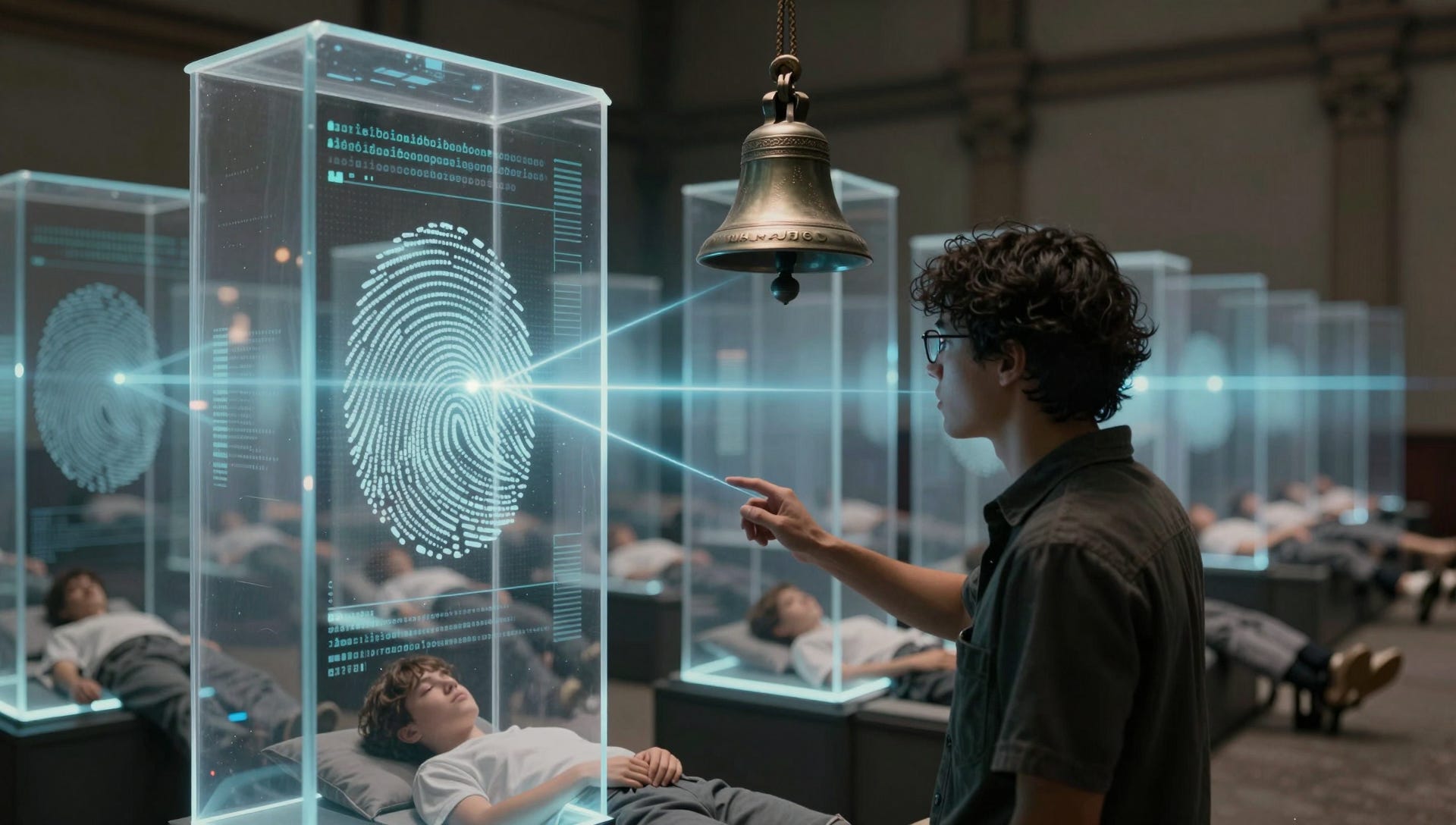
The closer we get to the present, the more this cocoon materializes and takes shape, the more we can see the nature of the web that envelops us. The Internet leads us, in a reified form, to what the electric monks only present metaphorically. In this very measure, the abstract laws of public space emerge, and it becomes apparent that a gaze that clings only to the physical surface passes over the complexity of what’s happening. As an exemplar, let’s take those identification techniques we’re increasingly confronted with: When fingerprints, faces, or irises are captured and used for biometric identification, my physical being is reduced to an appearance—and this appearance is then compared with a pattern no longer stored in the basement and its bean pod, but in a database. At this point, it depends on the program whether I’m approved and granted an access code or not. In any case, the political sphere has slipped into virtuality. The doubles described in Invasion of the Body Snatchers have been here with us for a long time. However, they’re not just doubles, monitored and controlled in the service of an alien power; but also entities under my own power and might that I can stage myself. I am—if you will—my own monastic aggregate, my own Big Brother, and because this is so, I’m free to put a whole range of Avatars and Identities into ecstatic convulsions.
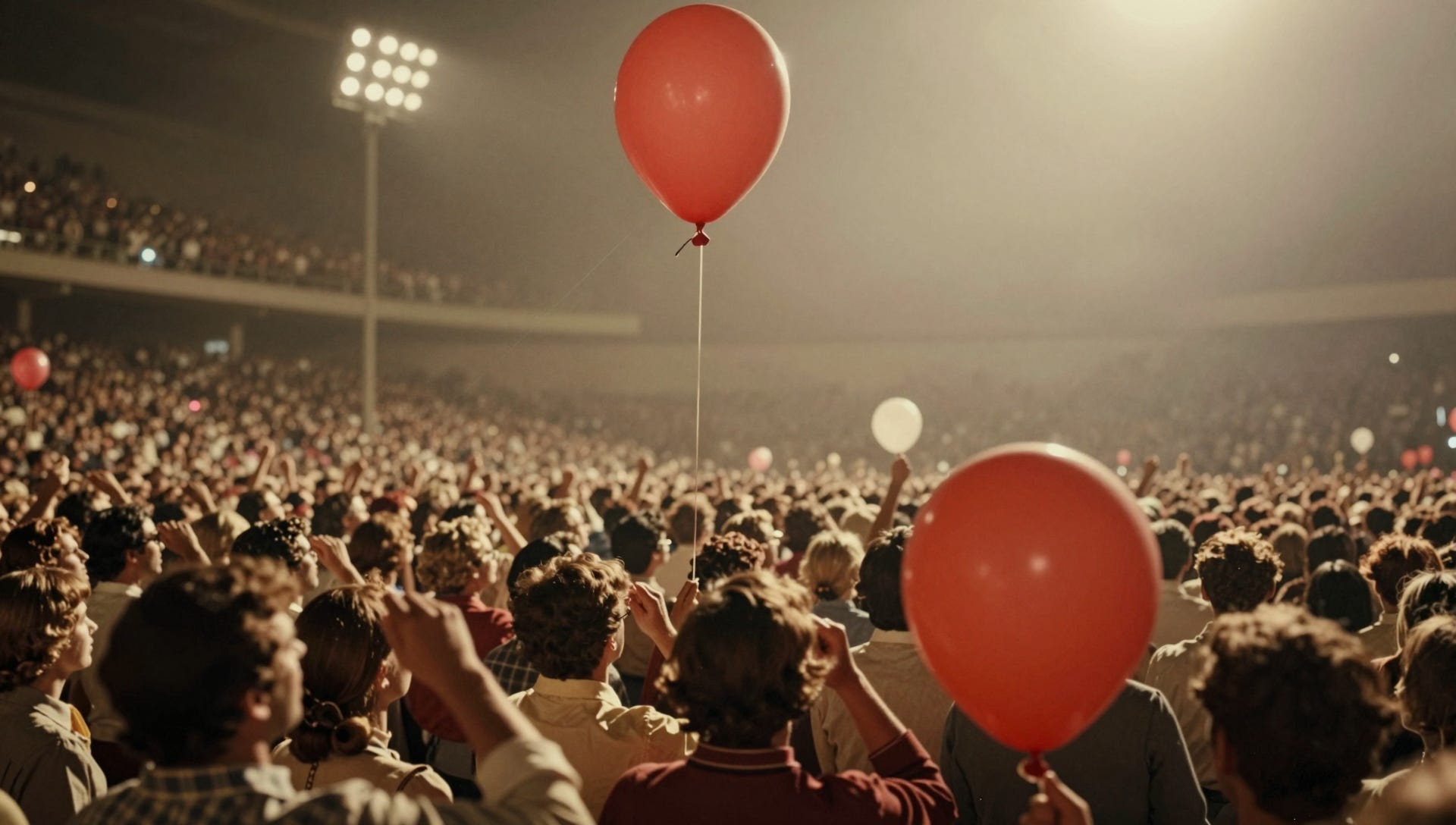
Like the church in the village, the public space isn’t a given but something that creates itself and—above all—constantly reinvents itself. Naturally, this brings us back into liturgical moments: the national team’s games, afternoon TV series, the rituals of the ever-same—in short, everything that connects an atomized television audience into a mass of excitement. It’s evident that this mustn’t be just an electric battery, but a meaningful, imaginary one—a battery that also knows how to satisfy metaphysical longings. Indeed, there’s a strangely utopian moment here in the public space—perhaps this is why this space is never satisfied with the given, but is always pointing above and beyond itself.
For this reason, the only goal of the public sphere is to become a different kind of public sphere: one that’s faster, more colorful, and more beautiful. It is a process in itself. It isn’t fixed or static, but rather (as a work in progress) constantly reinventing itself. It is its own performance—and without this performance, it wouldn’t exist. Or, put another way: the public sphere is Society’s attempt to become more like its own ideal. Auto-poiesis. Self-generation. Self-portrait.
Hence the general frenzy of design, the unleashing of signs, images, and surfaces—hence, with good reason, the dictum that design determines consciousness. If, in the meantime, political parties are advertised in the same way as detergents or deodorant sticks, this shows that public sphere specialists have long since left politics and are now much more at home in advertising. It equally appears to me that we’re dealing here with—well, with Art in public spaces, which I would like to include in my considerations, just as I wasn’t willing to exclude National Socialism. Whether you take an amusement park like Disney World, the neon architecture of Las Vegas, or Shopping Malls - it’s impossible not to attribute a suggestive grandeur to these spaces of experience. By the same token: If we wanted to draw a negative distinction between art in public spaces, speaking as purists who exclude these structures, we might have saved art but sacrificed public spaces in the process.
Let me slowly come to the end. When I said that there is no public space unless it’s simulated, I meant that what we call public space should be understood as an artifact and a product, a kind of collective Gesamtkunstwerk—a collective Work-of-Art. Furthermore, this means we should approach public space not as a given but as an open question. However, this question is by no means self-evident, let alone clearly articulated. To achieve this—strictly speaking, to step outside the system—it is necessary to disengage from what is taken for granted and to adopt an artificial ethnological perspective: essentially, to become a foreign body. You’d have to look at your own perception apparatus in the same way as you would look at public space, like an alien looking at our spatial speed. Only then would the code reveal itself in its entirety, showing how space is programmed. And that, in turn, would be my program—which I would jokingly call Alien Politics.
Only from this Alien-Postion, which is presented to us in films such as The Matrix or Invasion of the Body Snatchers – but as a split-off thing, does the question open up: How does the drive of this society work? What are the images and stories like? What are the sensory and mental Batteries that provoke a collective body of convulsive excitation? This strangeness, this Alien-Gaze, cannot be achieved by plunging into the fray of public life with a mission, but rather by withdrawing mentally from it—by looking at it as if it did not exist. Here, a return to history offers a chance: we can see (as wonderfully exemplified by the electric monks) how a highly complex system is shaped during its statu nascendi. Where the system has not yet fully unfolded, its energies become tangible, and the grammar of its space can be deciphered. This isn’t about history in the usual sense, but rather about stepping out of its spell and attaining ethnological distance. This perspective is the goal. History is only one way of reaching it; a number of other paths can be found—through experimentation, through what is not yet circulating in the system, through public scandal, performance, and intervention. As a small, harmless exemplar, I conducted a small experiment with my acting students. Armed with recording devices, I had them take the S-Bahn to the last station—where, as urban field researchers, they hiked the long way into the city, telling each other about this journey somewhere in a studio where the microphone running. And suddenly, in the middle of such a narrative—which has led the teller into an industrial no man’s land—they found themselves in absurd, seemingly ludicrous zones, realizing that even public space has its soft parts, its areas of shame, its intimacies.
In essence, the Alien-Gaze has always been an essential element of Art, drawing people to it: not taking anything for granted, not belonging, while adopting the Alien position. That, in a nutshell, is the interest driving me. Not identity, but Alien Politics. If you like, you can also see this as Fundamental Research. The term “fundamental” seems particularly apt in this context because we never encounter public space as a tabula rasa, as a primed white canvas. This space has always been described, coded—a battleground of different interests, approaches, restrictions. Insofar as we can’t simply assume the utopian empty canvas—we must first uncover the foundation with great effort. Only when this has been done do we have the freedom we need—if we’re pursuing an artistic interest. And with this freedom: a glimpse of what might be possible...
Translation: Hopkins Stanley
Freud’s nephew on both sides, Edward Bernays was the father of Public Relations, as he termed it, after, as some might say, the Germans had given propaganda.
N.B., I’ve written a chapter on this strange confabulation. See Burckhardt, M. — Perverse Moderne, in Über dem Luftmeer: Unbehagen in der Moderne, Berlin, 2023, pp. 128-149.
Related Content
Perverse Modernity

From Über dem Luftmeer/Vom Unbehagen in der Moderne, Berlin, 2023; Chapter 10, pp. 128-149
Alien Logic

The following is the visualization of a lecture Martin gave on May 11, 2021, at Vienna's IWM, where he spent a few months as a fellow in the spring following the publication of the Philosophy of the Machine. Because this lecture is a tour de force pulling together his previous thinking as a prequel to his five-book series, the
The Network Effect

The German original of the following text, which the readers of ex nihilo were able to witness as a »work-in-progress,« has been published in the latest issue of Lettre International
The Return of the Monster

What’s so different about our world compared to our parents and grandparents? It’s a seemingly inconsequential thought that’s on everyone’s mind. The funny questions of Where do I fit? and How do I define myself? – ones Martin’s consistently ignored since publishing