


From Über dem Luftmeer/Vom Unbehagen in der Moderne, Berlin, 2023; Chapter 10, pp. 128-149
Translation: Hopkins Stanley & Martin Burckhardt

Anti-Semitism is the most terrible Monster produced by Modernity.1 One of the greatest mysteries is how such a questionable writing as the Protocols of the Elders of Zion could become the blueprint for genocide, for which, despite all the blood-and-soil romanticism, the most advanced data technology was used. Specifically, Hollerith’s punch card machine, which had already proven its worth in the 1890 US census, was used for this purpose. After being transferred to IBM’s ownership, it was used to map the German »People’s Body« under the direction of its German subsidiary, Deutsche Hollerith-Maschinen Gesellschaft [DEHOMAG]. This was done with such efficiency that the data corpus reflected the exact population composition of each parish and city district. And because it included a demographic measure of the so-called Jewish density, it provided something akin to an extermination script for the Jewish population.
Put bluntly, the question is this: How could a culture committed to rationality subscribe to a conspiracy theory whose plausibility doesn’t exceed that of a Penny Dreadful? After all, it was already clear in 1921 that the Protocols were a crude forgery when journalist Herman Bernstein published his book The History of a Lie.2 Even more remarkable is how this forgery became the German catechism legitimizing their Jewish genocide—an idea that Hannah Arendt identified in her The Origins of Totalitarianism as the core question that historiography must address.3
Perhaps the biggest surprise awaiting historians tracing this text’s history is that its starting point stems not from anti-Semitic resentment but from an unease with Modernity. Moreover, you could say that modern anti-Semitism fills the vacuum that Modernity brought into the World. Just as the Guillotine is an act without a perpetrator, the Panopticon is sovereignty without a Sovereign, and the Market is thinking without a Thinker, anti-Semitism conjures up a Scapegoat to fill the vacuum. From then on, this Scapegoat is held responsible for injustices, whether real or imagined. Politician Hermann Rauschning, briefly a member of the National Socialist German Workers’ Party [NSDAP], and who exiled himself to America early on, recounts a short dialogue in which Hitler discusses World Domination, where, in response to Rauschning’s question about whether the Jews should be exterminated, Hitler replies that ›if the Jews didn’t exist, they would have to be invented.‹4 It’s important to have a tangible enemy, not just an abstract one.
If this idea paraphrases Voltaire’s aperçu – »If God did not exist, it would be necessary to invent him« – it’s worth noting that the logic of invention here doesn’t culminate in the apotheosis of the World Order as the best of all conceivable worlds, but seeks to blame an enemy for the flaws in the system. In this sense, »the Jew« is the Scapegoat of Modernity – the one who must serve as the Scapegoat for all the real or imagined hardships to which people feel exposed.

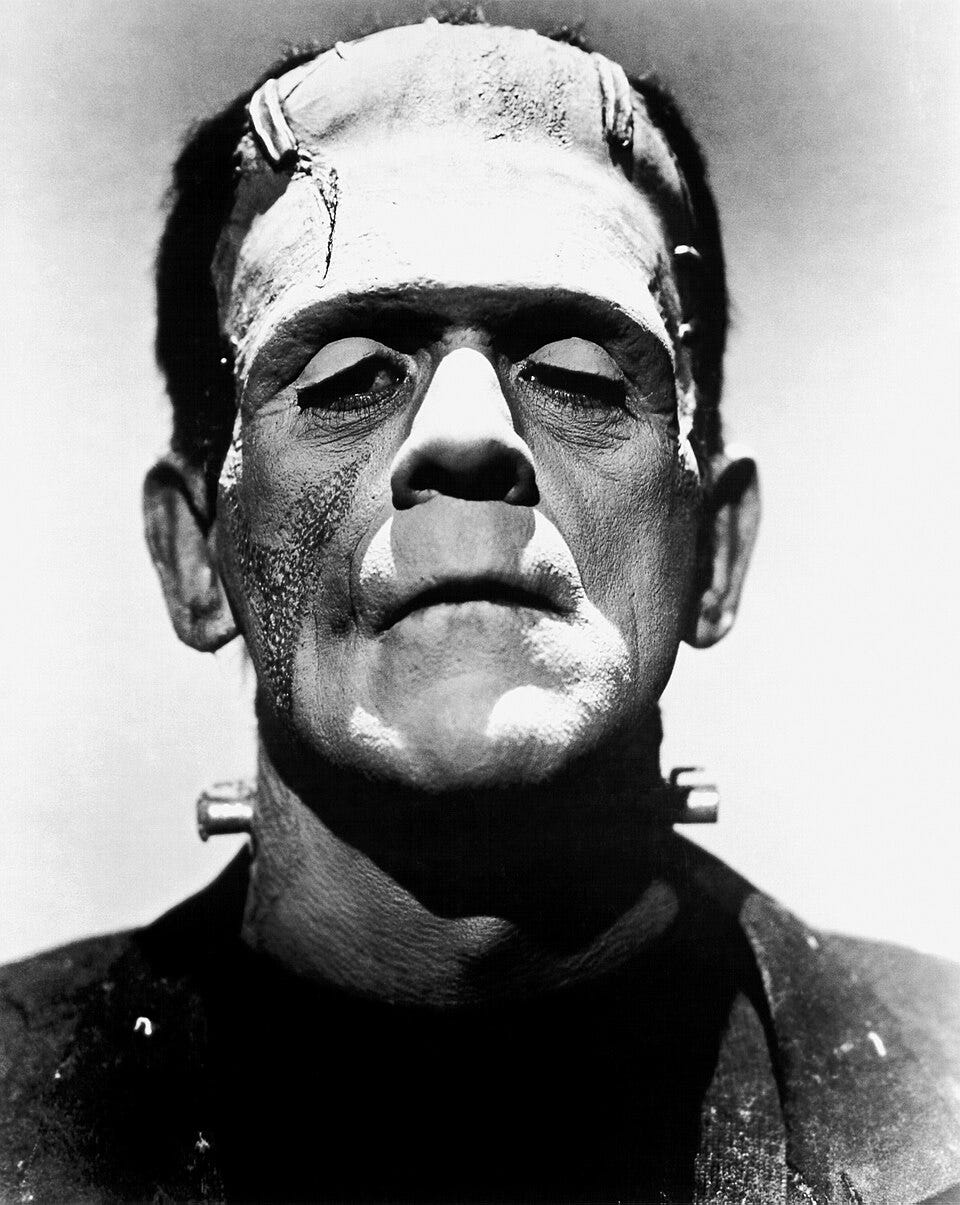
Origins of this global conspiracy theory can be traced to the writings of Abbé Augustin Barruel, who, in his Memoirs on the History of Jacobinism, imagined a grand Masonic conspiracy that couldn’t possibly be Jewish because Jews weren’t allowed to join.5 According to his account, in 1763 the French Freemasons established a secret literary academy comprising Enlightenment thinkers such as Voltaire, Turgot, Condorcet, Diderot, and d’Alembert, which regularly met at Baron d’Holbach’s home; their publications, in turn, challenged the morals and religion of the French people. From 1776 onward, Condorcet and Abbé Sieyes built a revolutionary movement of half a million Frenchmen, from which the Jacobins of the Revolution eventually arose. However, at the heart of this conspiracy, the revolution’s true leaders were the Bavarian Illuminati, led by Adam Weishaupt—the secret society from Ingolstadt that, as we learn from Mary Shelley, inspired her Dr. Frankenstein to create his monstrosities.
These »enemies of the human race, sons of Satan« had infiltrated society, using the very same networking logic demonstrated by Claude Chappe’s Optical Telegraph: »›And so‹, concludes Barruel, ›from neighbour to neighbour and from hand to hand the orders are transmitted with incomparable speed, for these pedestrians are delayed neither by bad weather nor by mishaps that normally befall horsemen or carriages; a man on foot can always get along when he knows the country, and that is the case here. They stop neither to eat nor to sleep, for each covers only two leagues. The mailcoach takes ten hours from Paris to Orleans, stopping for one hour; the distance is thirty leagues. Fifteen or twenty pedestrians, replacing one another, can reach Orleans from Paris in nine hours, using short-cuts and above all never stopping.‹«6
This nexus, in which a symbolic order is attributed to an adversary as the »enemy of the human race,« is the central theme. The advantage of this attribution of blame is immediately apparent: now you no longer have to deal with the strangeness of Scientific Modernity, but can operate on an equal footing, ad hominem. When the Abbé sees a viral form of transmission at work in the communication of news (from hand to hand, from neighbor to neighbor), he shows in the third part of his work that this form of proselytizing, this antisocial conspiracy, follows a viral logic7—whereby the conspiracy emanating from the Children of Light articulates itself as a form of infectious Mass Psychology. The revolutionaries’ bloodlust, which feeds on freedom and equality, is also linked to this in a hysteron-proteron reversal: “This is precisely where the origin of that revolutionary cruelty, that bloodlust, those insatiable prohibitions, those impetuous executions, and finally those banishments, which are more artful and cruel than the relentless guillotine, lies. «8
It was significant that Barruel’s conspiracy theory singled out Adam Weishaupt’s Bavarian Illuminati as central to the global conspiracy. This was a convenient target, insofar as the Illuminati were founded themselves as a Pythagorean secret society—an intellectual elite concerned less with Kabbalah and Alchemical techniques than with the affirmation of Scientific thought.9 Undoubtedly, the members’ secrecy provided a canvas for all kinds of projections, but even more than their reticence, it was the brotherhood’s elitism that attracted attention. Consequently, it wasn’t difficult for the Abbé to attribute the gathered intelligentsia’s elevated level of abstraction as distinguishing its members from the common crowd.
In this sense, the Illuminati appear precisely where the vacuum rises above the sea of air. The advantage of this juxtaposition, or more precisely, the humanization it embodies, lies in its ability to bring the threat of abstraction down to earth, while scaling the system down to a human level. Consequently, the Illuminati appear as puppeteers manipulating the unconscious masses with the greatest ingenuity.10 Because there is no longer any need to grapple with the problem of headlessness, of action without perpetrator, the element of the uncanny [Unheimlichen] is banished—that is, the Alien Logic that, although of human origin, is located at a level of abstraction that only machine-augmented reason can reach.
In his Elemente einer psychoanalytischen Theorie des Antisemitismus [Elements of a Psychoanalytic Theory of Anti-Semitism], Freud’s student Otto Fenichel points out that the unconscious remains foreign to us – making the stranger into a bearer of the uncanny. Contrary to what Psychoanalytic theory suggests, the uncanny in reason isn’t a reincarnation of outdated ideas; rather, it describes a new, modern form of deprivation. It’s the feeling that creeps over observers as they watch the bird struggle for air inside a glass container – and ultimately die. In this sense, Goya’s The Sleep of Reason Produces Monsters doesn’t refer to a temporary nightmare, but to an everyday occurrence: namely, that the Monsters born of reason’s dreams are, in a sense, an everyday occurrence, to the extent that they have taken root in Modernity’s things, institutions, and thought patterns. In fact, this is the actual meaning of the word Monster – the invisible that becomes visible, the phantom that takes on a body.
Barruel’s conspiracy theory could be seen as secularized anti-Semitism at work. Consequently, drawing on the medieval horror stories spread about the Jews, he claimed that during the September massacres of 1792, Jacobin fanatics had roasted and eaten Catholic priests.11 Clearly, he draws on the reservoir of historical anti-Semitism, in which all the archetypes of god-killers, well-poisoners, and enemies of mankind are prefigured. An early occasion that brought rather subterranean anti-Semitic reflexes to the fore was the assembly convened by the Antichrist Napoleon in 1806, which he called the Grand Sanhedrin in reference to Jewish jurisdiction. The meeting’s purpose was to answer 12 questions Napoleon posed to Jewish representatives—essentially to determine whether Jewish religious laws conflicted with the Code civil.12 The outcome was positive, and Jews were granted full citizenship. From then on, equality served as an entryticket to society, resulting in Judaism, as a visible group, dissolving into the Mass Society.13
Meanwhile, it took another half-century for the anti-Semitic narrative to reformulate itself. This delay is noteworthy because it makes clear that modern anti-Semitism must be understood more as a product of modern monstrosity and less as the fruit of millennia-old racism. Insofar as that, the literary foil that provides the theoretical framework for the Protocols of the Elders of Zion appears in a context that does not concern Jews, let alone any other minority. What is discussed in Maurice Joly’s The Dialogue in Hell between Machiavelli and Montesquieu (1864) is the modern techniques of power themselves. Above all, it is about Napoleon III, whom Victor Hugo, with a keen sense of the grotesque, christened Napoleon the Little and who was likened by his contemporaries to the Haitian Emperor, Faustin Soulouque, who had made voodoo Haiti’s State religion. With Napoleon III’s seizure of power, France became a failed State, politically corrupt but economically on steroids – which is why it’s not coincidental that Marx, looking at this short-legged, unsightly pretender, said that all world-historical things happen twice, »once as tragedy, the second time as farce.«14
After spending several years in Parisian government offices, Joly, a somewhat shy but highly rebellious lawyer, felt the need, as he recounts in an autobiographical essay, to expose »all the terrible abuses that imperial legislation had left behind in all branches of the administration, in all their abysmal depths. [...] I had the idea of conducting a dialogue between the living and the dead about current politics.«15 While the intention to portray Napoleon III’s rule as an authoritarian leadership state may cast the Second Empire in a very unfavorable light, it’s also true that the Emperor was especially gifted at presenting himself as a populist: a man of the people who expressed the passions of the collective better than anyone else.
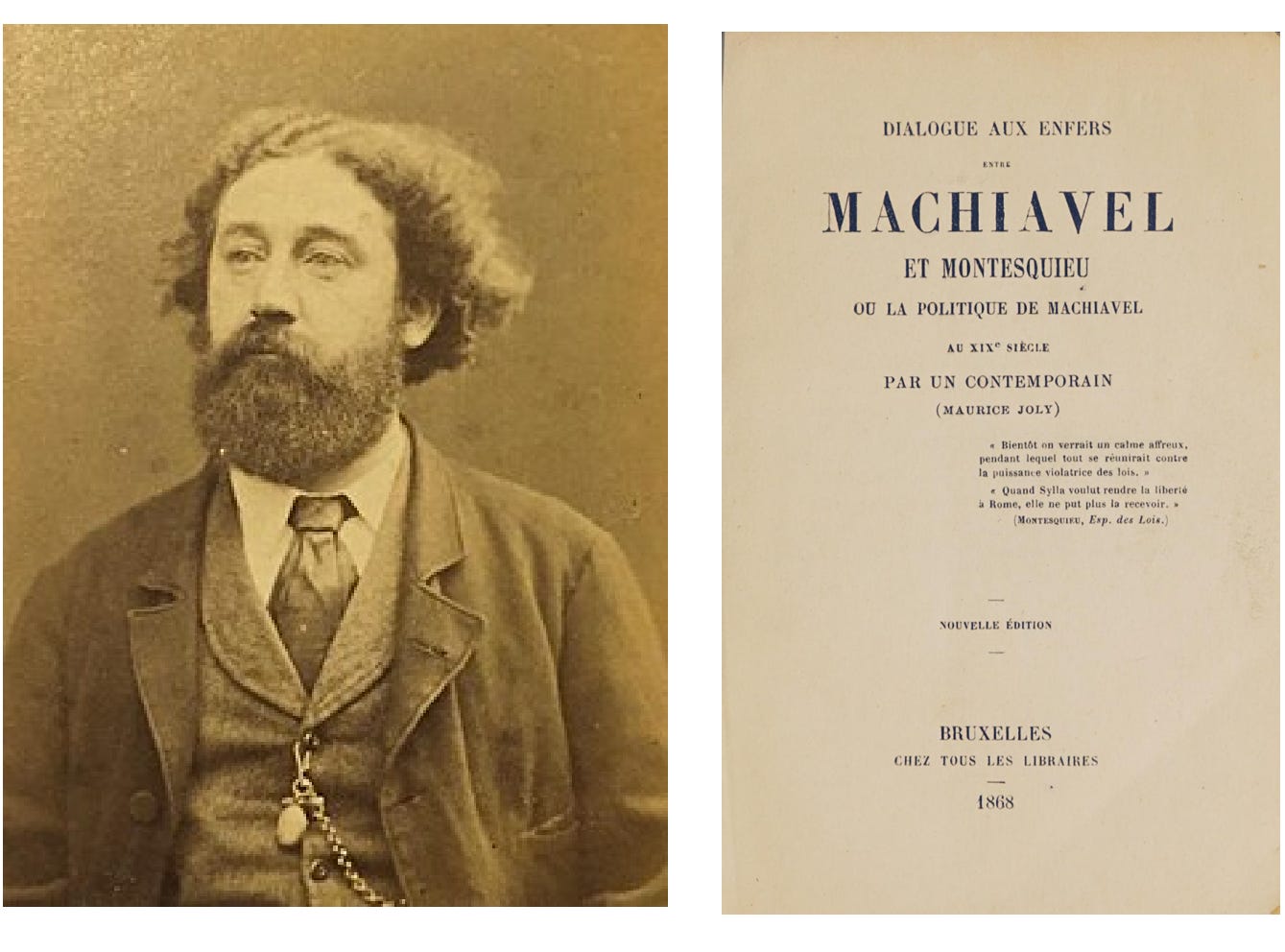
Paradoxically—no, appropriately—Louis Bonaparte himself had indulged in utopian socialism à la Fourier in his youth and had also written an anti-Capitalist book in which he blamed Jewish financiers in particular for the general misery—and for this reason alone, the masses who had been left behind were able to identify with him.16 Armed with plebiscites, the usurper succeeded in disempowering the liberal mind of 1848, replacing it first with authoritarian rule and then with the Second Empire. While some historians have labeled his power techniques as proto-Fascist,17 it could be said that Louis Napoleon succeeded in providing the emerging Mass Society with a figure it could identify with. In any case, he was a virtuoso of power who knew how to play the keyboard of a mass society like no one before him.

Because this is where Maurice Joly’s criticism comes in, he puts the following words into the mouth of his Machiavelli (aka Napoleon III):
»The usurper of a State finds himself in a situation similar to that of a conqueror. He is doomed to renew everything, to dissolve the State, to destroy the city, and to change the face of morality. That is the goal, but in this day and age it can only be achieved by devious means, by deception, by clever combinations and, as far as possible, without violence. So I will not destroy the institutions directly, but I will touch them one by one with an invisible hand that will disrupt their mechanisms. In this way, I will address the judicial system, the right to vote, the press, individual freedom, and education, one after the other.«18
The Emperor’s reference to the principle of the Invisible Hand may have originated in Economics, but it primarily corresponds to the seduction logic that Søren Kierkegaard inimitably laid out in his The Seducer’s Diary as the prototype of a perfect crime.19 This is so ingeniously constructed that the object of its machinations sees no reason to hold the seducer accountable for his actions—which brings to mind the exclamation in Lessing’s bourgeois tragedy Emilia Galotti: »What violence means is nothing: seduction is the true violence.«20 Joly writes: »To rule today is no longer a matter of committing acts of violence, beheading one’s enemies, expropriating one’s subjects, torturing them; no, death, expropriation, and physical torment can only play a rather subordinate role in the domestic politics of modern States.«21
The brute exercise of violence stands in contrast to the ideal of Modernity: the act without a perpetrator, in which manipulation is left to an invisible hand. If this description aroused the Emperor’s displeasure, which led to Joly’s immediate imprisonment, it was because he had uncovered the calculations of modern, populist power. This employs the most advanced means and anticipates what Edward Bernays would later ennoble in his classic 1920s work on propaganda as the discipline of Public Relations.
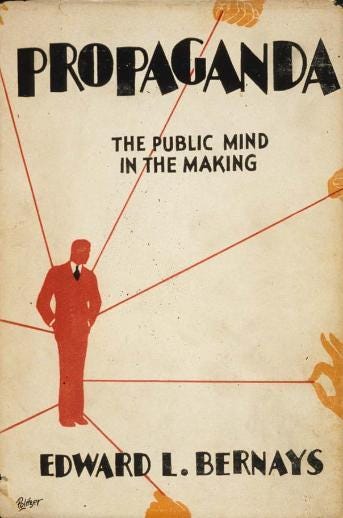
If, as Bernays argued, controlling public opinion is a standard tool of modern governance, the question becomes: How could Joly’s critical work on contemporary society evolve into the monstrosity we encounter in the Protocols of the Elders of Zion? The answer is easy in its complexity. Easy because the strangeness of the modern social system is imposed on the figure assigned the role of Scapegoat; complicated because here we’re dealing with a series of transcriptions and forgeries: a crime story, if you will.
This forgery’s strategy was as simple as it was ingenious: the Russian agent who picked up Joly’s long-forgotten book in the Bibliothèque nationale had to do little more than attribute the passages Joly had put into the mouth of his Machiavellian Napoleon doppelgänger to one of the Elders of Zion. If a statement like beheading a subject was no longer considered crucial, but instead accusations against judiciaries, the press, and similar entities, already sounded scandalous coming from the mouth of a cynical power politician, the idea that a small group of Jewish conspirators, somewhere in a back room of the Basel city casino, could have devised such a plan was equivalent to a diabolical global conspiracy. In any event, power has changed its form: it’s no longer a self-evident positivity that confronts the individual in a recognizable form; no, it’s a machination, a pretense, a form of social theater in which the puppeteers pull the strings in the background.
There’s no mention of this shift toward anti-Semitism in Joly’s work. To understand this transcription, we must first examine a second narrative strand that’s linked to German postal secretary Hermann Goedsche, who published horror stories and adventure novels under the pseudonym Sir John Retcliffe. Since the Anglophobic Goedsche was in the service of the Prussian secret service, but had been convicted of forging a letter as an agent provocateur—accusing the liberal politician Benedikt Waldeck of plotting to assassinate the Prussian king—he was forced to resign from his post. From then on, he devoted his energies to the staunchly conservative Association for King and Fatherland, which he headed as managing director, and to his literary career.22
In 1868, the historical adventure novel Biarritz was published. It includes a chapter inspired by a conspiracy scene inAlexandre Dumas’s novel: in it, Alessandro Cagliostro and other conspirators plan the Necklace Affair. Goedsche relocated his global conspiracy scenario to a Prague cemetery. Here, under the cover of night, the leaders of the twelve tribes of Israel gather, along with a thirteenth, clearly meant to represent the incarnation of Satan. The choice of location alone evokes a fantasy of revenants, with all manner of terrifying figures rising from their graves: Rabbi Löw’s Golem, the eternal Jew, the Kabbalah, the Jewish lust for gold.23 One after another, the leaders step forward, explaining how the world can be subjugated to Jewish supremacy: One must dominate the Stock Market, acquire Real Estate, ruin the Craftsmen, undermine the Church, discredit the Military, contribute to the disruption of social peace among various factions, conquer Trade, Government Offices, Culture, and the wombs of Christian girls, and, last but not least, dominate the Press and public opinion: »If gold is the first power in the state, then the press is the second.«24
Taken together, the two sources suggest that Goedsche’s horror story provides the decorum and stage design, while Joly contributes the underlying Political Philosophy.25 What is truly remarkable is how atavistic resentment merges with sophisticated Mass Psychology—this can only be explained by a general psychological willingness to believe in such a flimsy construct. In this sense, Hitler’s dictum, as handed down by Rauschning, is an expression of a collective desire – and this, in turn, insists on attributing a World Order that is perceived as incomprehensible, if not perverse, to a malefactor’s machinations. Only this desire explains how Joly’s criticism of Napoleon III’s populist practices of rule could be transformed into a blueprint for a global conspiracy.
In a sense, the Monster of Capitalism [Ungeheuer des Kapitalismus], or more precisely, the Telematic Society’s increasingly widespread Alien Logic, is banished as a foreign body. It could even be said that progressive Modernity and anti-Semitic activities advanced in lockstep, fueled by economic turmoil such as the global economic crisis of 1857 and the stock market crash of 1873.26 This explains one of modern anti-Semitism’s paradoxes—the more invisible the Jews were in the urban landscape, the more monstrous their reputation became. The void, if you will, gives birth to the corresponding Monster. In any case, anti-Semitism becomes an obsession indulged in by quite a few artists and scientists. In 1860, Gougenot des Mousseaux’s Le Juif was published, translated into German by Alfred Rosenberg in 1921, followed by Eugen Dühring’s Die Judenfrage: Racen-, Sitten- und Culturfrage [The Jewish Question as a Question of Race, Morals and Culture] in 1881 and Theodor Fritsch’s Antisemiten-Katechismus in 1893. In France, Édouard Drumont’s La France Juive, published in 1886, became a bestseller.
The text’s subsequent fate can be quickly told. In 1897, shortly after the first Zionist Congress in Basel, Pyotr Ivanovich Rachkovsky, the Paris agent of the Russian secret service, discovered a copy of the long-forgotten conversations between Montesquieu and Machiavelli at the Bibliothèque nationale de France. Armed with this book and a Russian translation of Goedsche’s Friedhofsfantasie [cemetery fantasy], he cobbled together a text that combineselements of pulp fiction with sharp political analysis—in such a crude manner that its stylistic inconsistencies remain striking even today.
Based on this template, Russian author Pavel Alexandrovich Krushevan, a fervent anti-Semite and member of the Black Hundreds, published a text in his magazine Snamya [The Banner]. This text legitimized the pogroms that his tireless agitation had triggered in his hometown of Chișinău, now the capital of the Republic of Moldova.27 Although this event shocked the International Community, it was only the prelude to a series of pogroms that erupted between 1903 and 1906, resulting in the murder of some two thousand Jews. The physical horror only served to intensify the impact of the Ochrana agent’s work, the heart of darkness.
In 1905, Russian novelist and mystic Sergei Nilus published a second, longer version, which he appended to his novel The Great in the Small.28 Nilus, convinced of the document’s authenticity—which doesn’t speak particularly well of his literary sensibility—claimed the manuscript had been given to him by a lady of French society who had come into possession of a translation documenting the Masonic-Jewish secret meeting in Paris—a statement Nilus later changed to refer directly to Theodor Herzl.
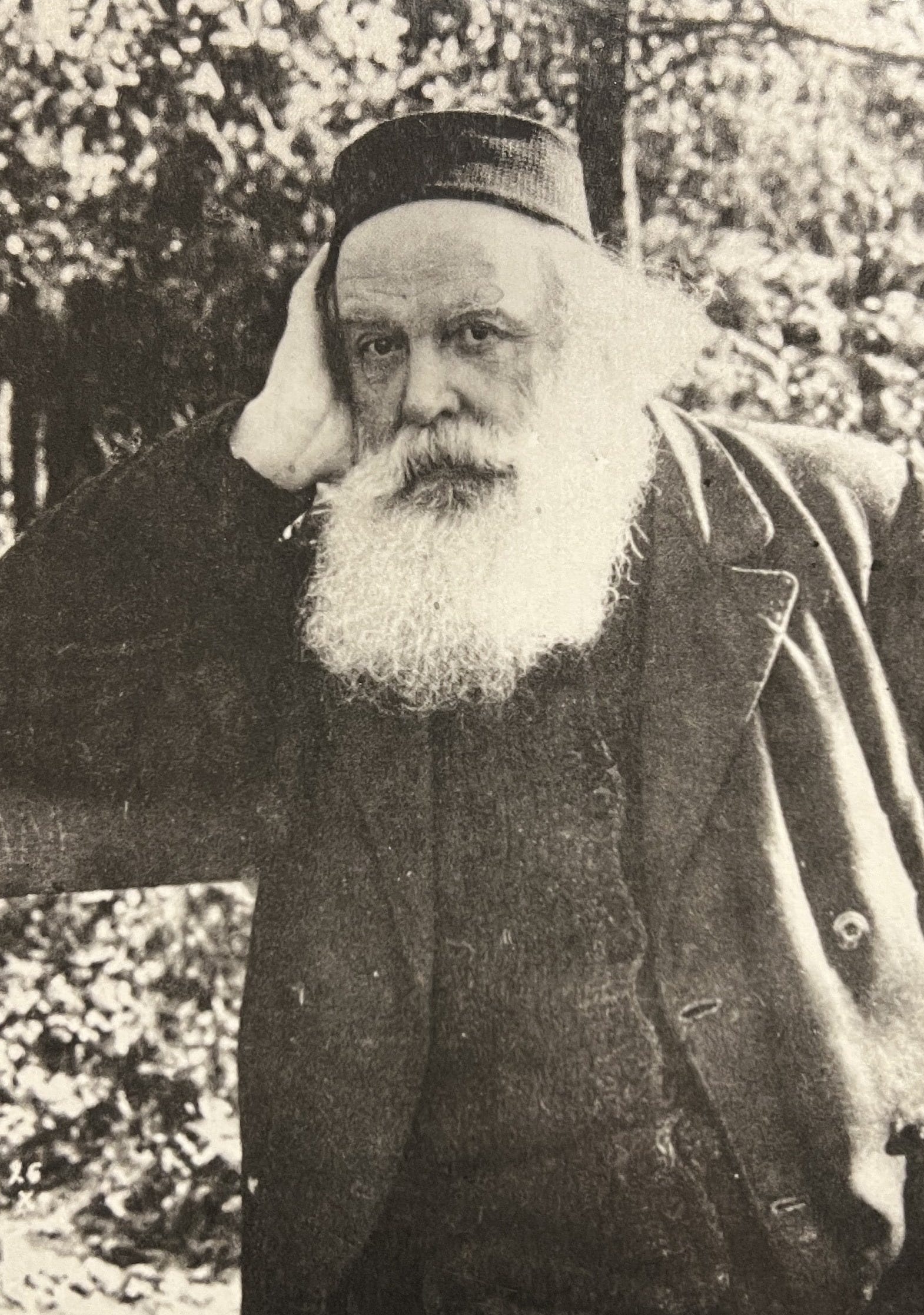
A third, further expanded edition appeared in 1906, penned by Russian journalist Georgij Butmi de Katzman. That the enemies of mankind were accused of further misdeeds was due to the political climate of the time, which was crying out for Scapegoats. Since the railway pioneer Sergei Witte, acting on behalf of the Tsar, had decreed a top-down modernization of the country, which abolished serfdom in 1861,29 social tensions had been steadily increasing. The war lost to Japan, which led to St. Petersburg’s Bloody Sunday and the 1905 revolution, was essentially the result of unbridled modernization, which imposed traditional corvée labor on workers and made any form of union self-organization a criminal offense—so that even fighting for an eleven-and-a-half-hour workday was considered a crime.
Blaming the Jews for the social unrest was, insofar, the classic Scapegoat solution. Consequently, the authorities were tempted to look the other way – or, worse, to actively stir up pogrom sentiment – thereby distracting attention from the real conflicts that socially and industrially backward Russia was embroiled in. Following the deceived-deceiver model, more than a few establishment figures, including the Tsar himself, believed that the Protocols were a contemporary historical document, thereby providing proof of an impending global conspiracy.30
Very soon, this belief spread far beyond Russia. Wherever violent social upheavals occurred, the Protocols were not far behind. Nations ravaged by war were particularly susceptible: typewritten copies circulated among Belarusian anti-Bolshevik emigrants at the Paris Peace Conference. Because the events of the October Revolution brought a period of general uncertainty, fears of social unrest took the form of conspiracy theories. Russian-language editions of the work appeared in Berlin, New York, Paris, and Tokyo, and in mid-January 1920, Gottfried zur Beek (actually Ludwig Müller von Hausen) published the first non-Russian version of the text. At the same time, industrial magnate Henry Ford—inspired by reading the Protocols—published a series of articles that whispered of a Jewish world conspiracy.
In the fall of that same year, the work was published in Boston under the title The Protocols and the World Revolution. In England, of all places, the renowned Times newspaper brought the text to the public under an ominous title: The Jewish Peril. An Arabic translation followed those in France, Poland, and Italy, as the Protocols suddenly became a global bestseller. The fact that Times reporter Philip Graves uncovered its similarities to Joly’s original didn’t mean the Protocols were over, as his article somewhat hastily claimed. Au contraire: Henry Ford followed up his Jewish-world conspiracy essays with a major work titled The International Jew. In Germany, Theodor Fritsch, who was responsible for the infamous Antisemiten-Katechismus, published another translation, which had sold 100,000 copies by 1933.
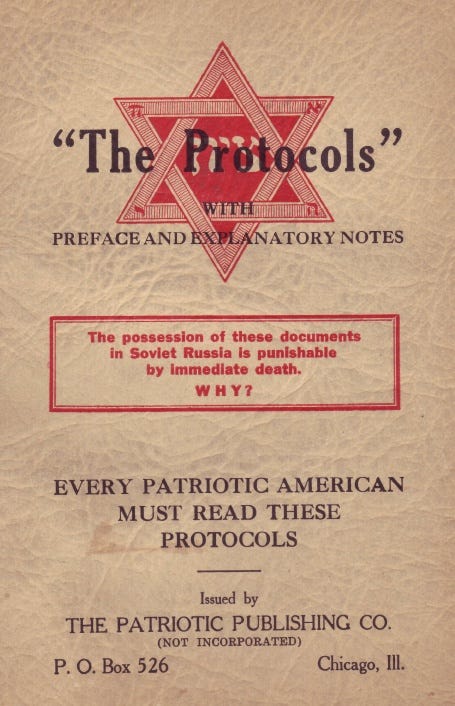
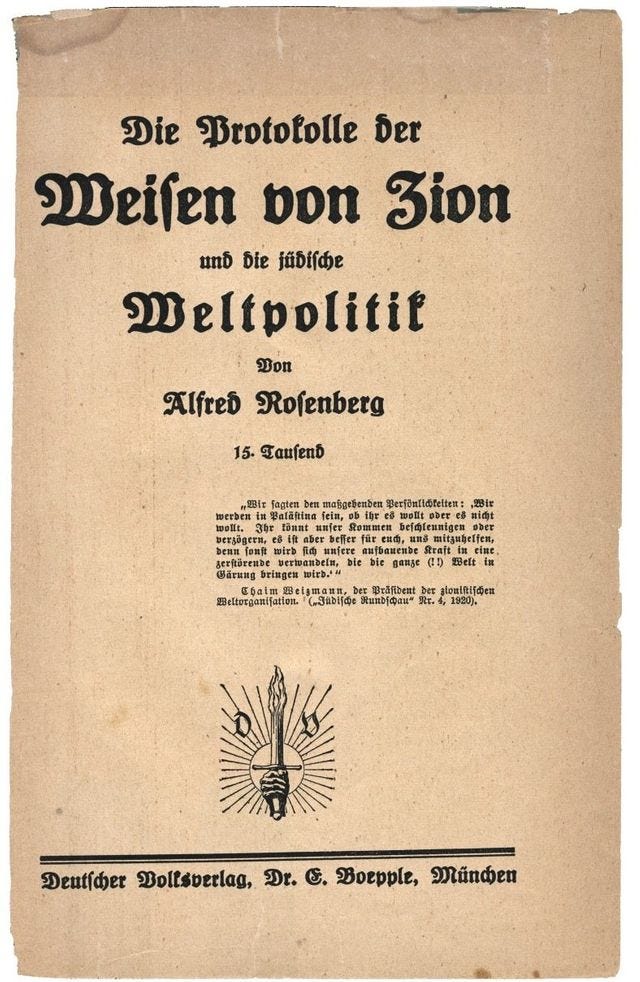
The German market was so receptive that it even accepted the version by Nazi ideologist Alfred Rosenberg, which went through three printings within a year. In 1929, the NSDAP acquired the rights to Beeck’s translation, and in 1933, excerpts from the Protocols were read in the Romanian parliament – and exploited by the Fascists there to justify the expulsion of the Jews. As late as November 3, 1939, shortly after the invasion of Poland, Hitler suggested that the work be further disseminated abroad to make it known that the Jews and Freemasons were truly responsible for the outbreak of war.
It is an enigma how such a text, lacking any internal consistency and which, because of its sentimental nature, reveals itself as the product of a rather questionable imagination, could become one of the most widely read works of literature. Equally puzzling is how the debate about this text, from Robert Graves to Bernstein to the great Berne Trial that exposed the Protocols as a forgery, was limited to the question of whether it was an authentic document or a forgery. As a result, the question of susceptibility to seduction, of anti-Semitic suggestibility, was hardly discussed any further. Thus, any analysis of the underlying problem – ›if the Jews didn’t exist, they would have to be invented‹ – remained in the dark.
A second, no less important concern is the fact that Joly’s criticism of Napoleon III doesn’t insinuate desecrated communion wafers, ritual murders, or well-poisoning; rather, it proceeds as a vivisection of contemporary techniques of power: the Press, the Judiciary, Education, and the like. The scandalon of Modernity is therefore nothing other than Modernity itself: the fact that it’s no longer about beheading its enemies, expropriating its subjects, or torturing them, but that Money, the Press, and Intellectual Manipulation provide much subtler techniques of domination.
But what added value do conspiracy theorists derive from this narrative? Following Freud’s insight that dreams are wish fulfillments, we might conclude that conspiracy theories are also wish fulfillments and that the idea of a global conspiracy should be understood as a daydream. This is precisely the escape from reality through artifice realized in the Protocols of the Elders of Zion. By dragging the Great Puppeteer onto the World Stage, Modernity’s threat of abstraction is neutralized. People no longer have to deal with the vacuum, the deed without a Perpetrator, or sovereignty without a Sovereign, any more than they have to deal with the remote effects of Telegraphy or Electricity. With the argumentum ad hominem, which is also accompanied by the distorted image of the subhuman, the perpetrator has been reduced to one's own level, ignoring the fact that there is such a thing as a space above the sea of air. For once you’ve rid yourself of such Alien Logic, you can claim that the moment the legitimate leader takes power, the impositions of Modernity will vanish into thin air.
Structurally, from an anthropological perspective, modern anti-Semitism is the counterpart of Voodoo religion, including Zombification—the evocation of a spirit world that Gustave Le Bon had already most astutely observed: »When people come together to discuss a question of politics, religion, or morality, it is the dead, not the living, who are talking about it. It is the souls of their ancestors that speak from their mouths, and their words are the echo of the eternal voices of the dead, to whom the living always obey.«31 Because blissful memories of the past protect us from the present, figuratively speaking, the king’s head has not yet fallen, and a concept of sovereignty can survive even though it had already been rendered obsolete by Hobbes’s collective figure of the Leviathan.
In a short 1924 text entitled The Loss of Reality in Neurosis and Psychosis, Sigmund Freud describes repression’s differing techniques by conducting the following thought experiment: He imagines a woman who loves her brother-in-law and is now standing at the deathbed of her sister, who has died unexpectedly. Now nothing stands in the way of her happiness—but she cannot allow herself to entertain this thought. According to Freud, the Neurotic would resolve this dilemma by denying her own feelings, while the Psychotic would deny her sister’s death. In the former case, the individual denies their own instinctual life; in the latter, reality itself. The Neurotic doesn’t deny reality; she just doesn’t want to know about it; the Psychotic denies it and seeks to replace it.32
With this distinction, Freud underhandedly introduces that the driving force doesn’t come from the child’s inner life, but pulsates within reality itself—which we’ve hitherto referred to as either a Social Drive [Gesellschaftstriebwerk] or as the Psychotope. »In Psychosis, the rejected piece of reality probably imposes itself repeatedly on the Psyche, as does the repressed drive in neurosis, and that is why the consequences are the same in both cases.«33 But as reality’s onslaught is inevitable, the Psychotic is not only forced to replace it with a fantasy world but also compelled to transform reality so that the conflict is eliminated, or at least mitigated.
In this sense, the term fantasy world is somewhat misleading because, like Potemkin villages, it can have very real characteristics. As an exemplar, the GDR’s Politburo would drive past the streets of Wandlitz on their daily commute to the East Berlin government district, which, unlike the rest of the city, had been modernized and neatly painted. This kind of reality enhancement could be seen as collective self-deception or even collective Psychotic behavior. Following this line of thought, Freud argues that Psychosis, »in a different, more self-aggrandizing way,« is interested in »the creation of a new reality that no longer offers the same stimulus as the abandoned one.«34
If we follow this line of reasoning, much of what we’ve come to call Ideology or Worldview could be understood as a form of collective Psychosis—an attempt to avoid perceiving certain aspects of reality.35 The degree of Psychosis depends on the intellectual and material effort that an ideology must expend to avoid acknowledging reality, or more precisely, the fundamental Psychotope. What psychologist Leon Festinger called cognitive dissonance could be understood as Psychotic energy translated into a cacophonous metric. That such Mass Psychoses are much less conspicuous than an individual’s delusional system simply has to do with how the collective body has no skin. Were it real, modern anti-Semitism could be understood as a form of phantom pain—like an amputated limb still causing pain.
On the other hand, in social life, people are not only confronted with the confusing absence of the painful limb but can also project onto others the illusion that it’s a temporary disturbance that will go away once the foreign body is removed or eradicated. There’s also a second factor: if you can cover up phantom pain by projecting the missing limb onto an enemy, the fantasy of sovereignty can stay intact. Seen this way, the foreign body to which all the World’s power can be ascribed corresponds to a suspended self-importance—a deeply narcissistic desire. Of course, this is an illusion, just as the invented Jew is the Scapegoat for a present that can no longer be eliminated. What suffers is the modern Psychotope, the Reality Principle itself.
In his early work, Zur Judenfrage [On the Jewish Question] from 1844, the young Karl Marx already noted that modern anti-Semitism takes its revenge on a Scapegoat. There, he calls for the emancipation of the State from Religion—or, as he puts it, the »decomposition of man into the Jew and the citizen«—and then, leaving this pseudo-question behind, turns to the conditions of actually existing Capitalism:
»Let us not seek the secret of the Jew in his religion, but let us seek the secret of religion in the real Jew. What is the worldly basis of Judaism? The practical need, self-interest. What is the worldly cult of the Jew? Haggling. What is his worldly god? Money. Well then! Emancipation from haggling and from money, that is, from practical, real Judaism, would be the self-emancipation of our time.«36
As we can see, he too is unable to escape the diabolical authority: because he conjures up the image of a vampire in the form of interest-bearing Capital, sucking the needy Capital, the Worker, dry – a mental image that can also be interpreted as a form of modern ressentiment. The fact that even Scientific Materialism fails in modern times only shows just how deep the desire is to avoid looking at the driving force [Treibwerk] itself – or, to be more precise, that here too we’re dealing with a mass psychotic energy.37 What becomes apparent here is the dialectic of Enlightenment, or more precisely, how reason fails in the context of a Mass Society, indeed under Mass Psychology. Serge Moscovici identified this marriage of politics and suggestibility as the hallmark of Modernity: politics is a rational means of exploiting the masses’ fundamental irrationality.38
In this context, modern anti-Semitism represents a battery of power that’s as sinister as it is effective. From a psychological perspective, its infamy lies in how, by accusing the enemies of the human race of plotting World Domination, it empowers itself to confront its diabolical adversary in exactly the same way. Interestingly, this projection process had already been observed in Hermann Goedsche. That an agent provocateur, who spies on his fellow human beings for the secret service while forging letters to accuse a hated politician of a murder plot, should develop the idea of a Jewish World Conspiracy only testifies to the fact that we’re dealing with a split desire. Because the responsibility for an individual’s own actions is placed on others, it’s possible to act with impunity. The anti-Semite has a clear conscience; he is, as Sartre so aptly put it, a »criminal for a good cause,« an »immaculate criminal.«39
In this sense, it is no longer necessary for the other side to take action, just as it’s not necessary to prove that such a conspiracy exists. Given the other side’s depravity, a preemptive strike is called for. You empower yourself to be modern—without taking responsibility for your own actions, let alone being willing to pay the price that Modernity demands. Having this in mind resolves an issue that has long troubled historians, or leaves them perplexed at the very least: the Modernity of National Socialism. You only need to consider National Socialist poster advertising from the 1920s to realize that every trick in the book was used in terms of mass propaganda.40 The Perverse Modernity of National Socialism becomes abundantly clear when the German Master set about organizing mass murder. Preparations began very much earlier, even before the political will and determination to make genocide a reality existed.

The first census on June 16, 1933, relied on the cooperation of DEHOMAG [Deutsche Hollerith-Maschinen Gesellschaft], an IBM subsidiary that distributed Hollerith’s punch card technology in Germany. The head of the census, Friedrich Burgdörfer, was a statistician and eugenicist who was involved in drafting the bill Zur Verhütung erbkranken Nachwuchses [On the Prevention of Hereditary Disease in Offspring].41 By 1936, armed with relevant population data from the census, the National Socialists already had an overview of which districts had the highest so-called Jewish density. Structurally, this made mapping the genocide out and writing its script for government agencies to follow a simple matter.42 Conversely, without such mapping, industrialized mass murder would have been unthinkable.
Genocide articulates what is structurally predetermined by the computer: that we are dealing with machinery for the administration of populations. It’s not coincidental but rather an expression of this perverse governmentality that every concentration camp operated its own Hollerith system and that the number tattooed on the prisoners’ forearms served as their Hollerith punch card number.43 »All Auschwitz inmate information, including workers still alive, deaths, and transferees, was continuously punched into the Hollerith system servicing the camp. Tabulated totals were wired each day to the SS Economics Administration and other offices in Berlin by the various camp Hollerith Departments. Hollerith tracking was the only system for monitoring the constantly shifting total population of all camps«44

Naturally, the obvious conclusion that data processing could be held responsible for the horror of genocide is absurd. The logic articulated here is rather that of division: the assertion of Racial Supremacy, while simultaneously transforming Modernity into a Machine of Destruction. In this sense, it is quite significant that the following two or three generations did not take note of the informational architecture of the Jewish extermination, instead fixating on the völkisch ideology of Blood and Soil. Meanwhile, the fixation on National Socialist Ideology has the effect of negating the driving force behind what one actually wants to dissolve: a Rationality that creates Monsters in Dreams.
This dilemma was made clear by August Bebel in his 1906 speech on anti-Semitism, in which he described anti-Semitism as a »new phenomenon.«
Berstein, H – The History of a Lie, New York, 1921.
Hannah Arendt clearly grasped this point: »In other words, if a patent forgery like the ›Protocols of the Elders of Zion‹ is believed by so many people that it can become the text of an entire political movement, the task of the historian is no longer to discover a forgery. Certainly, it isn’t to invent explanations that dismiss the chief political and historical fact of the matter: that the forgery is being believed. This fact is more important than the (historically speaking, secondary) circumstance that it is a forgery.» See Arendt, H. – The Origins of Totalitarianism, New York, London 1980, p. 7.
»I asked whether that amounted to saying that the Jew must be destroyed. ›No,‹ he replied. ›We should have then to invent him. It is essential to have a tangible enemy, not merely an abstract one.‹« See Rausching, H. – The Voice of Destruction, New York, 1940, p. 237. – This short dialogue confirms the analysis given by Jean-Paul Sartre in his text Reflections on the Jewish Question. »Thus, the anti-Semite is condemned to be unable to live without the enemy he wants to destroy.« Sartre, J. – Betrachtungen zur Judenfrage, in: Drei Essays, Frankfurt/M, p. 120. Interestingly, Sartre understands anti-Semitism as a »passion« – so it is actually only a small step to see the homo dolorous of Modernity at work here. The idiosyncrasies that Sartre attributes to the anti-Semite are consistently characteristics of Modernity: money, stocks, division of labor, immaterial labor, and the »rational constructs of abstraction.« [Trans. MDB]
Barruel, A. – Mémoires pour servir à l‘histoire du Jacobinisme [Memoirs Illustrating the History of Jacobinism], Lyon, 1819.
Cohn, N. – Warrant for Genocide. The Myth of the Jewish World Conspiracy and the Protocols of the Elders of Zion, Chicago, 1969, p. 31.
»The way to spread the universal light is not to proclaim it to the whole world at once, but to begin with oneself: then turn to your nearest neighbor; the two of you can enlighten a third and a fourth; let them in the same way increase and multiply the number of children of light, until the number and strength throws power into our bonds.« Abbé Barruel, Memoirs Illustrating The History Of Jacobinism, Vol. III, New York, 1799, p. 117 (trans. MDB).
Ibid., p. 13 (translation MB).
It’s noteworthy that Weishaupt’s system design showed a certain affinity with Bentham’s panopticon from the outset. In 1776, he wrote in a letter: »...and in specie I make everyone a spy on the other and on all.« Engel, Leopold. – Die Geschichte des Illuminaten-ordens [The History of the Illuminati Order], Berlin, 1906, p. 76. The goal of the enterprise is the »eradication of prejudice,« that is, the increase of reason.
Once again, it’s Sartre who reads the transformation of the mass event into the individual sphere as a signature: »Anti-Semitism, a bourgeois phenomenon, thus appears to us as the will to explain mass events through the initiative of individuals.« Sartre, J. – Betrachtungen zur Judenfrage, in: Drei Essays, Frankfurt/M, p. 125. [Trans. MDB]
Barruel, A. – Histoire du clergé pendant la Révolution Française, London, 1801.
Specifically, the objective was to determine if the Jewish religious community would have a problem with the Code Civil (polygamy, divorce, marriage, and interaction with non-Jews, and so on), but most importantly, whether it was prepared to sign a declaration of loyalty to the French state.
Hannah Arendt highlighted this shift—from court Jew to citoyen—in her The Origins of Totalitarianism.
Marx, K. – Der achtzehnte Brumaire des Louis Bonaparte [The Eighteenth Brumaire of Louis Bonaparte], in: MEW, vol. 8, p. 115. [Trans. MDB]
Joly, M. – Son passé, son programme, par lui-même, Paris, 1870, p. 14 (trans. MB).
Schapiro, J.S. – Louis Napoleon. Statesman in: Brian Dowling-Gooch (ed.), Napoleon III. Man of Destiny; Enlightened Statesman or Proto-Fascist?, New York, 1963, p. 73.
Ibid.
Joly, M. – Dialogue aux enfers entre Machiavel et Montesquieu [The Dialogue in Hell Between Machiavelli and Montesquieu], Brussels, 1864, p. 86 ff. (Trans. MDB).
Jean Baudrillard has devoted a short book to the Diary, which addresses the question of seduction.
Gotthold Ephraim Lessing, Emilia Galotti, ed. Rainer Siegle, Stuttgart, 1992, Act 5, Scene 7, p. 81.
Joly, M. – Dialogue aux enfers entre Machiavel et Montesquieu [The Dialogue in Hell Between Machiavelli and Montesquieu], Brussels, 1864, p. 71.
»When all the gold of the earth is ours, all power is ours. Then the promise given to Abraham will be fulfilled. Gold is the new Jerusalem—it is the rule of the world. It is power, it is retribution, it is pleasure—in short, everything that people fear and desire. That is the secret of Kabbalah, the doctrine of the spirit that rules the world, of the future!« Sir John Retcliffe, Biarritz, Berlin, 1868, p. 166 ff.
»If all the gold on earth is ours, all power is ours. Then the promise given to Abraham will be fulfilled. Gold is the new Jerusalem—it is world domination. It is power, it is retribution, it is pleasure—in short, everything that people fear and desire. That is the secret of Kabbalah, the doctrine of the mind that rules the world, of the future!« Sir John Retcliffe, Biarritz, Berlin, 1868, p. 166 ff. [Trans. MDB]
It is noteworthy that Karl Marx, in his early work Zur Judenfrage [On the Jewish Question] in which he calls for the emancipation of the state from religion – as he puts it, the »decomposition of man into the Jew and the citizen« — he then turns to the conditions of actually existing Capitalism and interprets anti-Semitism as a symptom of interest-bearing money.
»Thus the world-conquering plans of the Elders of Zion came out of Goedsche’s trashy novel. But the Elder’s political dogmas and schemes, as well as the moral principles that were their foundation, came almost word for word from the speeches of Machiavelli in Joly’s petty satire on Napoleon III. Now there were two sources from which the Elders of Zion must have fashioned their wisdom. Later, we shall deal with the plagiarisms in detail and, by means of textual comparison with the original, we shall make the thefts clear.« Segel, B.W. – A Lie and a Libel: The History of the Protocols of the Elders of Zion, Lincoln, London, 1995, p. 67.
A book that interpreted the advancing globalization, the »invisible hand« of Capitalism, as the cause of the First World War was the work of the Austrian politician Friedrich Wichtl, Weltfreimaurerei – Weltrevolution – Weltrepublik [World Freemasonry – World Revolution – World Republic], which was published after the end of the war in 1921.
The Commission for the Investigation of Pogroms identified Pavel A. Krushwan as the intellectual ringleader of the pogroms. See Commission for the Investigation of Pogroms, published by the Zionist Relief Fund, London, Die Judenpogrome in Russland [The Pogroms Against the Jews in Russia], Cologne, 1910.
Nilus, S. – The Jewish Peril. Protocols of the learned elders of Zion, London, 1920.
It’s worth noting that Witte himself emphasized the connection between Modernity and the abolition of serfdom as a conditio sine qua non. According to Witte, after the Crimean War, it was decided that serfdom had to go if Russia’s reputation in the world was to improve. von Laue, T.H. – Sergei Witte and The Industrialization of Russia, New York, 1963, p. 174.
Evidence of the extent that modern resentment affected even the highest government officials willing to implement reforms was provided by the military writer Aleksey Kuropatkin, who noted in his diary after the terrible pogrom in Chisinau at Easter 1903: »I heard from Plehve, as from the Emperor, that the Jews must be taught a lesson, that they gave themselves airs and were the leaders in the revolutionary movement.«Quoted from von Laue, T.H. – Sergei Witte and The Industrialization of Russia, New York, 1963, p. 203 [trans. MDB].
Le Bon, G. – Psychologie du Socialisme, Paris, 31905, p. 75 [trans. MDB].
Freud, S. – Der Realitätsverlust bei Neurose und Psychose [The Loss of Reality in Neurosis and Psychosis], in: Gesammelte Werke, Band XIII, London, 1940, p. 365.
Ibid., p. 367.
Ibid., p. 366. [Trans. MDB]
Sartre writes: »Thus, from the outset, the anti-Semite professes a de facto irrationalism. He defends himself against the Jew as feeling defends itself against reason, as the individual defends himself against the community, as the past defends itself against the present, as the concrete defends itself against the abstract, as the landowner defends himself against the owner of mobile assets.«” Sartre, J. – Betrachtungen zur Judenfrage, in: Drei Essays, Frankfurt/M, p. 118. [Trans. MDB]
Marx, K. — Zur Judenfrage, in: MEW, Bd. 1, S. 372. [Trans. MDB]
Gustave Le Bon captured this problem very clearly: the overestimation of legality and institutions, while simultaneously underestimating the economic powerhouse: »A simple chemical reaction that takes place in a laboratory ruins one country and enriches another.« Le Bon, G. – Psychologie du Socialisme, Paris, 31905, p. 2. [Trans. MDB]
Moscovici, S. – The Age of the Crowd, New York, 1986, p. 24.
Sartre, Betrachtungen zur Judenfrage, in: Drei Essays, Frankfurt/M, p. 132. [Trans. MDB]
It is said that Le Bon inspired Benito Mussolini, and this is highly likely to have been the case with Hitler as well. Hitler writes in Mein Kampf: »While the entire human culture is only the result of the creative activity of the individual, in the entire, but above all in the highest leadership of the national community, the principle of the value of the majority comes to the fore and from there gradually begins to poison the whole of life, i.e., in reality, to dissolve it.« (p. 498) If the Führer Principle» is pitted against a mass society here, he has no problem with populist pandering: »All propaganda must be popular and its intellectual level must be adjusted to the receptivity of the most limited among those to whom it is intended to appeal. Thus, the greater the mass of people to be reached, the lower its purely intellectual level must be.« Hitler, A. –Mein Kampf, Munich, 8511943, p. 197. [Trans. MDB]
In the chapter on Mann in der Menge [The Man in the Crowd], we saw that other great statisticians such as Francis Galton and Ronald Fisher were also involved in eugenics programs. See Burckhardt, M. — Der Mann in der Menge, chapter 9 in Über dem Luftmeer: Vom Unbehagne in der Moderne, Berlin, 2023, pp. 117-127.
Black, E. – IBM and the Holocaust: The Strategic Alliance between Nazi Germany and America’s Most Powerful Corporation, New York, 22002, p. 58 ff.
This was true at least in the early days. As the number of victims grew immeasurably, this practice was abandoned. See Black, E. – IBM and the Holocaust: The Strategic Alliance between Nazi Germany and America’s Most Powerful Corporation, New York, 22002, p. 352.
Ibid., p. 353 ff.
Related Content
Sociosis

When I try to explain in conversation the extent of the fall that accompanies the loss of reality, I repeatedly find myself referring to a subtle distinction that Sigmund Freud discussed in his seminal work The Loss of Reality in Neurosis and Psychosis
