


This essay was first published in Lettre International, 153
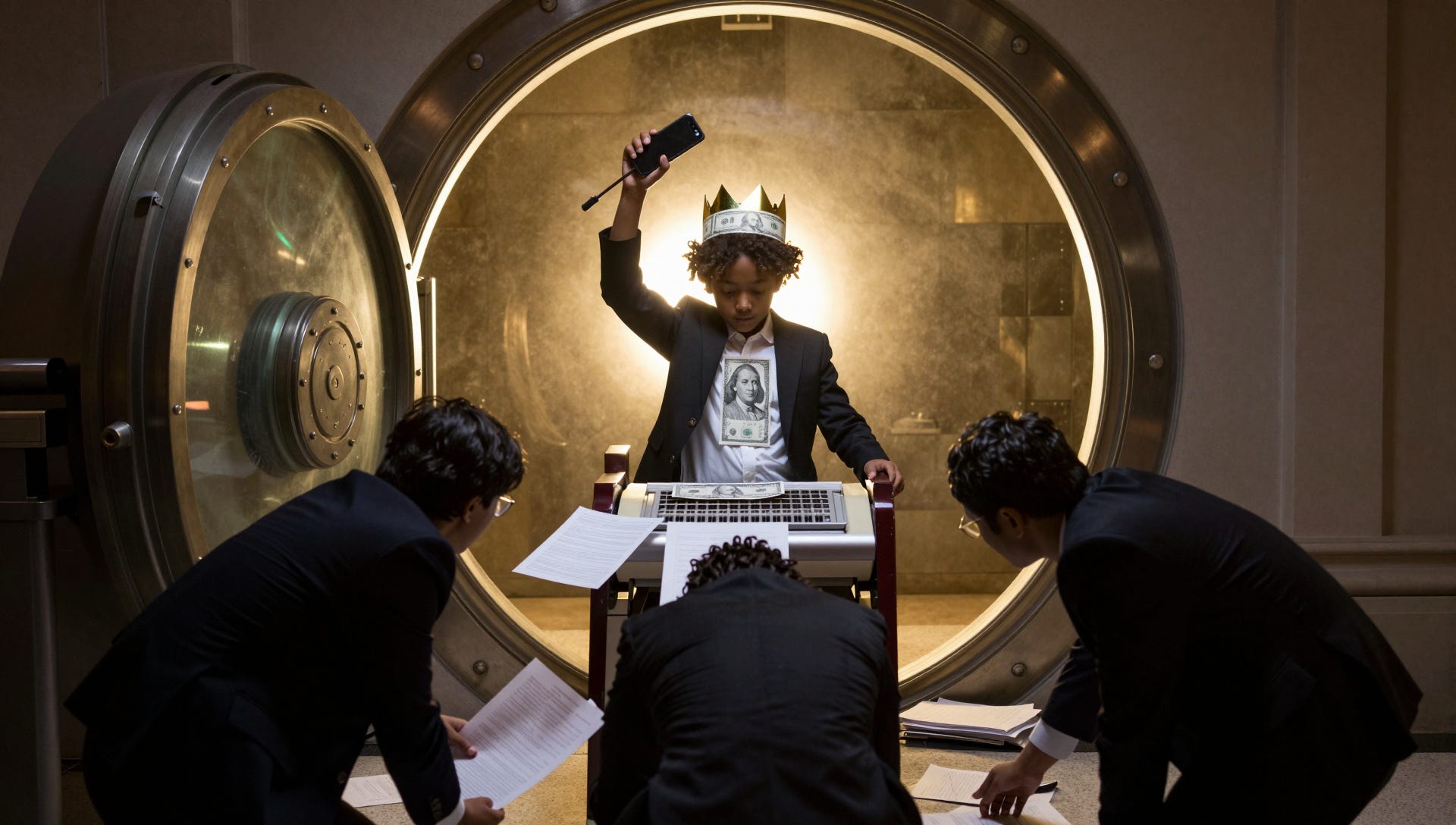
When speaking of nihilism, one inevitably stumbles into the realm of heroic nihilism, into that Nietzschean world which, with the dictum »God is Dead«, proclaims the devaluation of the highest values and has understood the Will to Power as the actual Triebwerk [driving force] of World History. Even if we shrink away from following Nietzsche on his intellectual path toward the Übermensch, we run the risk of becoming lost in a philosophical labyrinth1—and this problem certainly doesn’t exclude the proletarian version either. For while Dostoevsky’s Notes from the Underground portrays his contemporary as an Underground Man, we are dealing with a gesture of resistance that, averse to all authority, has nothing else in mind but tearing down the existing order: Destroy what destroys you! That 19th-century Russian anarchists were primarily recruited from the offspring of wealthy families suggests that nihilism could be understood as a luxury belief turned into activism. Whether we’re now witnessing the philosophical overthrow of the gods or following the Russian student who, in the self-education club, makes the decision to bomb the Russian tsar out of existence —what gets overlooked in this heroic reading is the possibility that nihilism does not, as Nietzsche decreed, demonstrate the highest power of the mind; rather, it should be understood as the ultimate intellectual impasse, as the desperate attempt to transform one’s own powerlessness into its opposite. Endowed with such a post-heroic reading, the question must be asked: what exactly does this experience of powerlessness consist of? When William Faulkner once said: »Given the choice between the experience of pain and nothing, I would choose pain.« this statement allows only the conclusion that the horror vacui represents a more abysmal experience of pain. One could speak of a Weltschmerz, or more precisely, a pain of losing one’s worldview, which, insofar as it confronts the afflicted with the possibility of losing one’s mind, seems even more unbearable than physical torment. In approaching the question of nihilism from this perspective, current aberrations of the zeitgeist (such as the Environmental Movement’s enthusiasm for the Apocalypse) can be understood as symptoms of such uncertainty. And because here—and this is the novelty—self-awareness is even less pronounced than in the case of moral nihilism, the activists of the Vulkan Group can boast that they still took care of the snails on the power pole before setting it on fire a few minutes later.2 Accordingly, the project to save the world proves to be a nihilistic act which, because it is entirely unreflective, comes across as even more total than its historical precursors. Why? Because with the death of god, the escape into religion is blocked. And because one can no longer even work oneself up into a messianic complex, one’s compelled to pass off one’s own actions as a form of higher rationality. Only in this way can one delude oneself into believing that the motivation for one’s actions is not the salvation of the World, but the salvation of one’s own worldview. But where does this uncertainty about one’s worldview stem from? With this question, the tableau takes on a different, psychological form. Consequently, nihilism could be understood as a symptom of a far more profound drama that still preoccupies us today: the horror of horror vacui, the sensation of witnessing the disappearance of one’s own convictions and articles of faith. And because this drama falls into the psychological register that led T.S. Eliot to the closing lines of his Hollow Men (This is the way the world ends / Not with a bang but with a whimper), we will no longer concern ourselves with the Big Bang of metaphysics, but rather with that whimper that has haunted our post-horror, postmodern era.
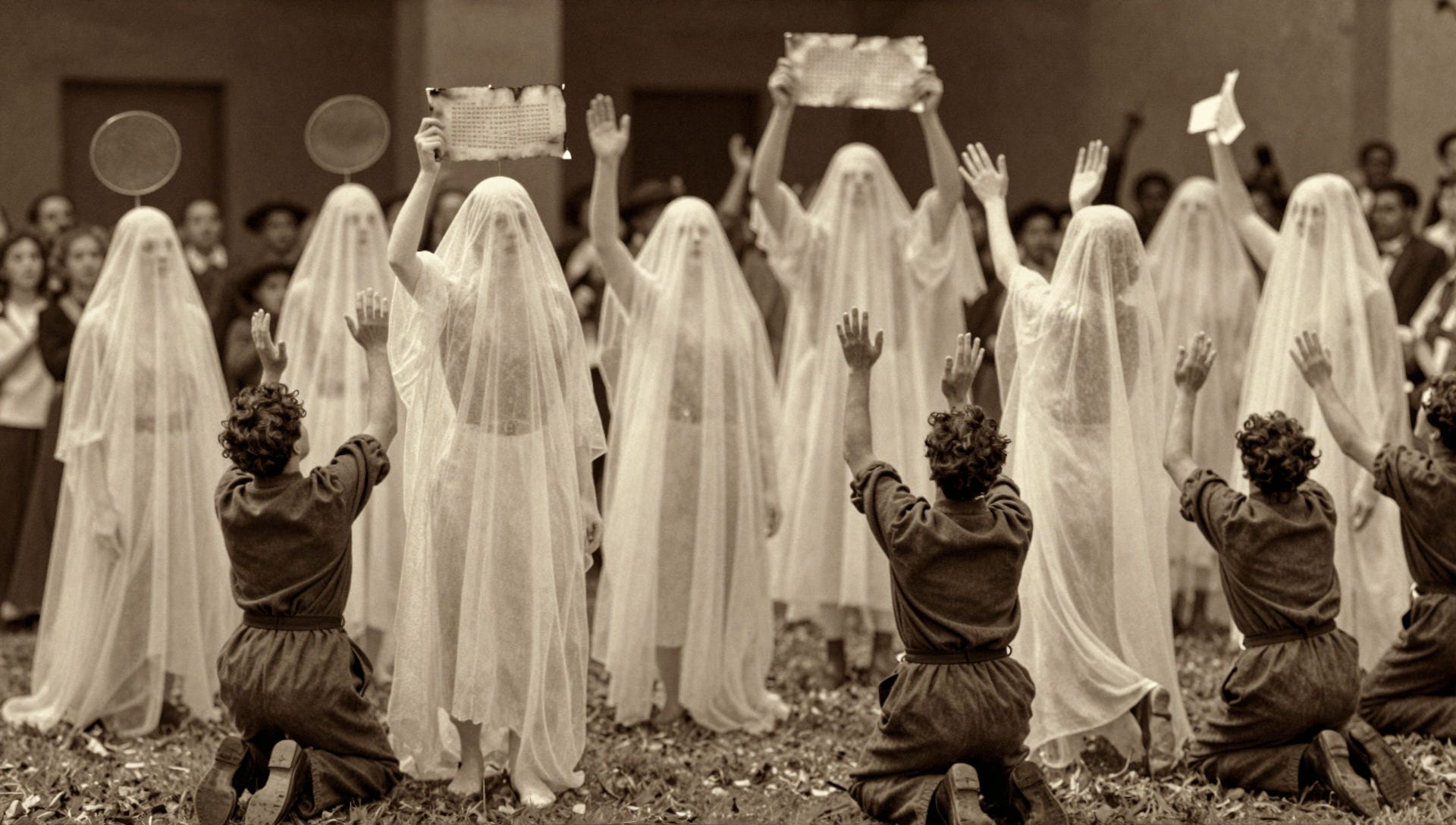
If we take the beautiful quote from David Fincher’s Fight Club: »With the money we don’t have, we buy things we don’t need to impress people we don’t like,« it’s striking that here we’re dealing with a series—no, more than that: with an escalation of negations. This raises the question: What drives an individual to become caught up in such a form of futility? What is it that’s at stake in this struggle? Quite obviously, neither money nor material goods can satisfy the underlying desire. In this sense, the dilemma itself goes beyond Plutarch’s astute observation that one grows weary of all things but not of money: it is the only thing that makes humans insatiable. So what is even stronger than Capital’s promise of transcendence? This question brings us closer to the real dilemma. It seems quite obvious that the desire to be seen and noticed is even greater than the desire for wealth and possessions. Or to put it another way: the narcissistic humiliation of not being noticed cannot be alleviated, neither by goods nor by Capital. This brings us to a historical rupture sociologists describe as a transition to a post-material society, but which should be understood more precisely as the transition to an Attention Economy. AI pioneer Herbert A. Simon already summed up this connection in 1969, noting that in the Information Society, the Consumer’s attention is the truly scarce commodity.3 While this remark still reflects the cyberneticist’s worldview, systems theorist Georg Franck translated the concept of the Attention Economy into general economic terminology in the late 1980s, with the simple observation that money can be printed at will, whereas the Consumer’s attention is limited. While he (and his numerous followers) believed that attention had brought a profoundly human quality to the center of the Economy, the longue durée shows, however, that this was and remains a somewhat naive notion. Not only are we dealing with an act of deprivation, but moreover, metrified attention has transformed its character in the Internet World. In this sense, one comes much closer to the problem by understanding the hunger for attention as a narcissistic disorder—and the satiation of this need as a form of pseudology, or worse: as a new Midas complex. Just as the king of the myth, endowed by Dionysus with the wondrous talent to turn every object he touches into gold, is doomed to starve, so too is the one who craves media recognition condemned to a similar fate: one craves attention, but one starves on it. The explanation for this drama is relatively simple. After all, in the Attention Economy, we’re ultimately dealing with a spiral of one-upmanship—or more precisely: a spiral of underbidding, in which sex and crime, that is, the lower angels of human nature, attract the most attention. One could speak, in a literal sense, of a logic of privation. Not only is the individual compelled to commodify his own self, but the Limbo Economy also forces him to lose himself in the moment, in the momentum. Subjected to the dictatorship of the »One«, he is—as a free radical—catapulted into a state of extreme alienation. The Marxist philosopher Ernest Bornemann, who attempted to supplement Freudian thought with a Midas complex, made the apt observation that use-value concerns qualities (the this or that of the corresponding good), whereas exchange-value translates the object into quantity—and thus, in a radical way, disregards it entirely4 It is precisely this logic that the individual must contend with: He isn’tunderstood as who he is, but is evaluated based on whether he is capable of functioning as a multiplier—which has given us the job title of influencer, a career goal envisioned by nearly one in three of today’s youth. Undoubtedly, the promise of rising to stardom overnight is a temptation of the highest order—all the more so because this fame need not be linked to any particular skills. If Kim Kardashian’s butt can be turned into a piggy bank that magically spits out dollars, one might convince oneself that the age of the virtuoso is a thing of the past, and that it’s therefore a futile endeavor to strive for excellence in any discipline. One is famous simply for being famous. What is not apparent in this promise is the price the individual must pay for it. He must expose himself to the whims of a public that savors, evaluates, and, when in doubt, imposes ostracism on every unconscious gesture. And because this can happen every day, 24/7, one could almost speak of an exorcism of the private. If Blaise Pascal said that human misery stems from the fact that one cannot remain alone in one’s room, this begs the question: Who is still alone in their room these days? Because insofar as everyone has an Avatar hanging around their neck in the form of a smartphone, they are both present and absent at the same time. In this sense, connectivity marks a form of the Midas touch; the individual, transformed into a Me, Inc., is thrust into a form of schizophrenia. Here, the Natural self corresponds to a symbolic entity, the Avatar, which must be turned into gold—that is, monetized. Recalling that the Midas story goes back to a Phrygian king of the 8th century—to a time, in other words, that had just experienced the transition from TempleMoney to secular coinage5—we realize that we’re not merely encountering a mythological figure here, but the prototype of a society that, driven by a hunger for money, that is, the horror of abstraction.

That we’ve placed nihilism at the center and linked it to the upheaval of the new, digitalised Gesellschaftstriebwerk[Social Drive] points to a historical paradigm shift hasn’t really been grasped as such. When sociologists have vaguely referred to this as a transition to a post-material society, this primarily reflects a lack of conceptual clarity falling far short of meeting the scarcity function described by Herbert A. Simon. One reason for this conceptual blurriness may be that the social change coincided with the student revolution—which is why the heroic interpretation has been favored. However, when approaching history as a historical materialist, it quickly becomes apparent that the World Revolution’s dream paths led nowhere, whereas the Digitalisation of the Gesellschaftstriebwerk still preoccupies us today (which led me to the joking remark: Imagine there’s a revolution, but nobody was there). In fact, the year 1968 saw a whole series of radical revolutions that were generously overlooked by contemporaries preoccupied with other matters.6 That IBM was forced in an antitrust case to recognize the separation of hardware and software might be dismissed as a historical trifle, just as the fact that the separation of head and body was repeated in medicine: for in order to permit organ transplantation, an ad hoc commission at Harvard felt compelled to define the moment of death as brain death. More importantly, however, 1968 saw the privatization of Arpanet—previously reserved for military purposes—thus paving the way into the world of the Internet. In fact, this also marks a watershed moment in politics. As the world shrinks into a Global Village through networking, borders become porous, and the fiat privilege—the monetary sovereignty of Nation-States—inevitably begins to falter. And sure enough, shortly thereafter, the Bretton Woods system established in the postwar era collapsed. Not only did money become detached from the materiality of gold, but politics also had to get used to the fact that Capital was no longer at home in the capitals, but that anonymous global financial markets, in a state of free floating, now determined the value of money. If we ominously label this state of affairs Globalization, Bill Clinton (shortly after the repeal of the Glass-Steagall Act, that is, the last barrier to investment) went so far as to claim that Globalization is the economic equivalent of natural forces, such as wind or water.7 Such a naturalization leads one to lose sight of the fact that we are ultimately dealing with a paradigm shift in the symbolic order—and that Capitalism is undergoing precisely this earth-shattering metamorphosis as a result. Failing to recognize this led the Masters of the Universe into the financial crisis of 2008-2009. Bearing in mind that this disillusionment affects not just the Economic Guild but essentially every citizen of the World, it’s evident that we’re dealing here with a humiliation that goes far beyond the narcissistic slights Freud documented in his Civilization and Its Discontents. While the abandonment of the geocentric worldview may have represented a cosmological humiliation, this experience of loss was largely reserved for the educated class—whereas digitalised humiliation affects the conditio humana itself. For if today every job that has been successfully digitalised falls prey to the Museum of Work—and can henceforth (Anything, Anytime, Anywhere) be retrieved from the Working Memory—it becomes clear that a sense of self-worth nourished by wage labor and the logic of economic exploitation is, sooner or later, doomed to annihilation. And we don’t even need to consider the disruptions that Artificial Intelligence is set to bring our way. In its starkest, most brutal form, this annihilating logic is encapsulated in the threat of proliferation posed by the Boolean formula that underpins binary logic: x=xn.8 If every digitized good is, by its very nature, infinitely reproducible and thus superfluous – even when this involves complex work processes – then this means nothing less than that the past’s canon of values, based on scarcity and originality, is a thing of the past. While this may remain a vague sense of threat, or even mere background noise, developments over the past decades show that we’re dealing with a material transformation of the Gesellschaftstriebwerk—not just merely a disturbance of the collective psyche.

With this in mind, it’s clear that the question of nihilism cannot be addressed solely from the perspective of individual psychology. Understanding nihilism—in the tradition of Nietzsche and Dostoevsky—as a heroic gesture and as the defiant resistance of a loner who breaks away from social conventions risks completely overlooking its collective dimension. As undeniable as it is that Digitalization is eroding our highest values, it cannot be overlooked that this is perceived as a disruption, provoking corresponding resistance. The question is to what extent a society is even capable and willing to face such a shaking of its very foundations. When Victor Hugo said that there is nothing more powerful than an idea whose time has come, one could justifiably object: ›Yes, there is something more powerful—namely, an idea whose time has passed!‹ Oscar Wilde described this mechanism magnificently:
»For a sentimentalist is simply one who desires to have the luxury of an emotion Without paying for it To propose to spare your mother’s pocket was beautiful To do so at my expense was ugly. You think that one can have one’s emotions for nothing. One cannot. Even the finest and the most self-sacrificing emotions have to be paid for. Strangely enough, that is what makes them fine. The intellectual and emotional life of ordinary people is a very contemptible affair. Just as they borrow their ideas from a sort of circulating library of thought — the Zeitgeist of an age that has no soul — and send them back soiled at the end of each week, so they always try to get their emotions on credit, and refuse to pay the bill when it comes in.«9
Now, the denial of the actual operating system, even more: the sentimental appropriation of the past, is the hallmark of our time. Great again! This may explain why nihilism doesn’t really find itself but, by embellishing itself with grandiose fantasies of the past, successfully evades any self-knowledge. In a sense, one numbs phantom pain by indulging in phantom pleasure. The effects of this mental escapism can be observed everywhere. When truth, beauty, and goodness are available for less than their cost, it’s no wonder that Art degenerates into kitsch, Truth becomes bullshit, and Morality comes across primarily as a display of virtue, as moral grandstanding. One could, following C.G. Jung, speak of a psychic inflation in which, above all, values are invoked that fuel the individual’s sense of grandiosity. One thinker who observed this development early on is Christopher Lasch, who meticulously dissected the psychological mechanism in his Culture of Narcissism. When people suffer from a barren inner life—a world in which, apart from the fictionally conveyed fantasy of grandeur, only shadowy images of themselves and others exist – the only way to numb the feeling of emptiness is to imagine a punitive superego that punishes or belittles those who prevent the individual from realizing their desires.10 In short, this is the politics of resentment. In a sense, one needs the subhuman (the metaphysical Nazi, the racist, the fossil-fuel-dependent polluter) merely to make one’s own trauma bearable. It is evident that such thinking, so saturated with the past, can do nothing to alleviate psychological distress. At best, the gnawing self-doubt can be appeased by taking pleasure in denigrating others. The sinister saying has been handed down by Hitler: If the Jew did not exist, one would have to invent him.11 This thought reveals the psychological mechanism with complete clarity. One detail is particularly noteworthy here. The Other, who is degraded to a subhuman or less-than-human, nevertheless possesses abilities that one lacks oneself: When anti-Semitism has indulged in notions of a global conspiracy in which Jews dominate capital, the press, the arts, and public opinion, it articulates an inverted fantasy of grandeur—the longing to emulate this other.12 In a sense, the belief may take hold that once one’s arch-enemy has been eliminated, the means and tools will be at one’s disposal to shape one’s own destiny as one pleases. Moreover: Because of accusing the Other of engaging in sinister machinations, one is now oneself, in the sense of a preemptive strike, empowered to do to the Other exactly what he is accused of—a logic of self-empowerment allowing one to storm with all one’s might into the dark chamber of cognitive dissonance.
When Nietzsche called nihilism the most uncanny of all guests, he hit upon an essential point: the phenomenon that nihilism by no means articulates itself in an unchanging form, but that the moment of metamorphosis is inherent in it—a metempsychotic, highly uncanny dimension, as it were. In a curious way, this applies to the promise of post-Modernism, which has gone down in history as the promise of Anything Goes. While this was enthusiastically hailed as a liberation, people generously overlooked the fact that the Nietzschean maxim ›Anything goes‹ carries a dark legacy within it, as this was the motto of the Order of Assassins, which gained sinister notoriety in the 11th century for its assassinations. Insofar as this is the case, one could say that post-Modernism, too, following the logic of the Midas story, has been haunted by a vague, placeless horror. For everything that aroused desire has turned into a tremendum, into a panic-stricken terror. The metamorphosis that has befallen the Internet is telling. While in the early days it could be celebrated as the birth of civil society, as a grassroots movement and a rhizomatic order that left behind the traditional logic of representation simply because every citizen now had a voice, the spirit of the times now recoils from the consequences of this liberation, and lamentations about antisocial media, hate, and incitement are ubiquitous. Something similar applies to the enthusiastically expressed conviction that, thanks to the Internet, the world’s knowledge is accessible to everyone. Because the enthusiasm for archived world knowledge has given way to lamentations about fake news, internet bubbles, and disinformation campaigns. If one were to give this logic a form, one could link it to Jenny Holzer’s Protect me from what I want. Just as Midas’s hunger for gold, at the very moment of its realization, brings the dark undercurrent of desire to the surface, one recoils from the materialization of one’s own desire—indeed, ultimately, from oneself. If we follow the idea of the Midas complex, we can say that the tremendum expressed in this story refers to the emergence of an alien system of order. In the case of Midas, it was coinage that shattered family ties and, indeed, the tribal order itself. Thus, the myth, as fantastical as it may seem, speaks to a very real shift—the collapse of what might be called the money illusion. Now, this isn’t merely a phantasm, but a practice that encompasses every conceivable sphere of life and leads to almost everything being measured in terms of money. Viewed in this light, the upheaval accompanying it is more radical than the individual-psychological perspective on the Oedipal disorder suggests. Consequently, the criticism that the Marxist Ernest Bornemann levels at the bourgeois family novel of Freudian origin is entirely justified—for in the form of money, we are dealing with an externalized social unconscious (what I have called a Psychotope13). And this brings us to a point essential to the analysis of contemporary nihilism. What is articulated in the digital upheaval is the emergence of a new continent of thought that detaches us from traditional conventions—and, in this sense, unleashes disruptive, even annihilating, forces. From this perspective, it’s entirely understandable—and even expected—that many contemporary reactions exhibit a nihilistic structure. But how does Society respond to such a paradigm shift? Here we come to a point where—once again—a reference to Nietzsche can be helpful. When he said that madness is very rare in individuals but the rule among groups, parties, peoples, and eras, this can be taken as evidence that deviant behavior, which in individuals might suggest psychosis, meets with acceptance in social life—no, more than that: it can be the rule. For unlike the individual, a society can quite successfully engage in denial of reality—and thus what may appear to the skeptical observer as psychic inflation may, for the majority, be a perfectly acceptable, if not the economically dictated way of life. Consequently, collective psychosis (which should rather be called Sociosis) can in turn transform itself into an economic rationale. In fact, it doesn’t take much of a mental leap to be convinced of this observation’s validity. If, in recent decades, classical Economics has gradually fallen by the wayside and been replaced by a Moral Economy(which, depending on the context, manifests as either wishful thinking or an apocalyptic enthusiasm for catastrophe), this can be understood as a form of collective repression. One numbs phantom pain by indulging in fantasies. The tendency toward hyperbole is impossible to overlook. When one indulges in apocalyptic invocations of a climate catastrophe—since nature does not contradict—then one has scaled a peak from which one can effortlessly declare a state of emergency. 14 Just as Carl Schmitt decreed that »sovereign is whoever decides on the state of emergency,« there lies a wonderful opportunity to overcome the inner feeling of emptiness by finding refuge in political theology.

This, it seems to me, is precisely the hallmark of contemporary nihilism. For this nihilism doesn’t, by any means, take the form of the heroic lone warrior, nor does it defiantly insist on the futility of human existence. Quite the contrary: because a gaze into one’s own inner world would be all too terrifying, one joins the chorus. This, it seems to me, is precisely the hallmark of contemporary nihilism. In the safety of the cohort, one can indulge in the invocation of noble concepts—whether it be saving the world, the whales, or the purity of language. Now, it’s by no means the case that the author of these lines didn’t share these noble goals—or that he would dismiss the respectful treatment of minorities, the need for environmental protection, or the prevention of species extinction as trivial matters. Not at all: However, following Marie von Ebner-Eschenbach’s maxim (»The opposite of good is good intentions«), he’d never prioritize the intention but always the practical solution. But precisely because the activist lacks this very quality, he finds his true self only in symbolic politics—by fighting the battles of the past, exorcising the past, and driving out its ghosts. Psychologically speaking, we’re dealing with a disturbance in which the free, isolated individual, in order to avoid being excluded, submits to the dictatorship of the crowd—following catchphrases that make one feel as though they’re on the right, safe side. And because it is unbearable to sit alone and isolated in front of the smartphone, people embark on thumb crusades, scrolling their way to the other end of the world and attacking all the specters they can blame for their misery. This is all the more commendable given that such activities are rewarded with loyalty points or, if one succeeds in rising to the forefront of such a MeToo movement, can, in the Attention Economy, be converted into cold, hard cash. While the Society of the Spectacle was still an avant-garde project in the 1960s, performative self-expression has now virtually become a civic duty. If one is insubordinate here, this (silence is violence) can lead to highly unpleasant consequences. Anyone familiar with the late Middle Ages will not have any trouble connecting these performative acts of self-expression to the disconcerting social phenomena of the 14th century: the Children’s Crusades, acts of self-flagellation, and the inquisitorial zeal with which dissenters were cross-examined. What’s striking here is the extent —or even the fact— that our contemporaries grapple not with reality but with specters—specifically those that emerge in the digital sphere. Consequently, people turn a blind eye to real-life problems, whereas outrage over digital violence immediately leads to legislative proposals. Where the phantasm summons the law onto the scene, the law loses itself in the phantasm. Now, the presumption of office, as a result of proven impotence, doesn’t lack a certain sense of comedy—but the grim seriousness with which the actors pursue their plans raises fears that we’re being pushed back into a dark age, a world where neither the presumption of innocence nor due process holds any significance. The extent of this regression becomes clear when recalling that the supposedly dark Middle Ages displayed astonishing legal considerations. As an exemplar, in 1386, a trial was held for a sow that had bitten off an infant’s arm, thereby causing the child’s death—during which the sow was dressed in human clothing, assigned a lawyer, and given a proper trial. The animal’s piglets, although beneficiaries of the crime, were acquitted. Nevertheless, great symbolic value was attached to the event, as evidenced by the fact that the execution was immortalized in a fresco in the Church of St. Trinité in Falaise. Contrasting this with our current practices, in which the guilty party is subjected to the Instant Karma of a digital pillory, cancel culture reveals itself above all as a moment of cultural loss.15 The return of the Thymotic, indeed even the desire for inherent annihilation within these media spectacles, can be understood as a symptom of profound emptiness. In this sense, political activism serves only to simulate the power to act. However, in reality, one is dealing with fortifications that transform our contemporaries into inhabitants of their own Potemkin village, entrenching them in their imaginary structures. Quite obviously, it is more bearable to convince oneself of the continued existence of familiar thoughts, ingrained patterns, and familiar faces than to expose oneself to nothingness, to the fact that the devaluation of traditional values has long been a fait accompli. In this sense, nihilism is first and foremost a form of involuntary resistance. Because the symbolic order, the Psychotope, established contra naturam, originates as an invention,16 Don Quixotism is the preferred option over horror vacui.
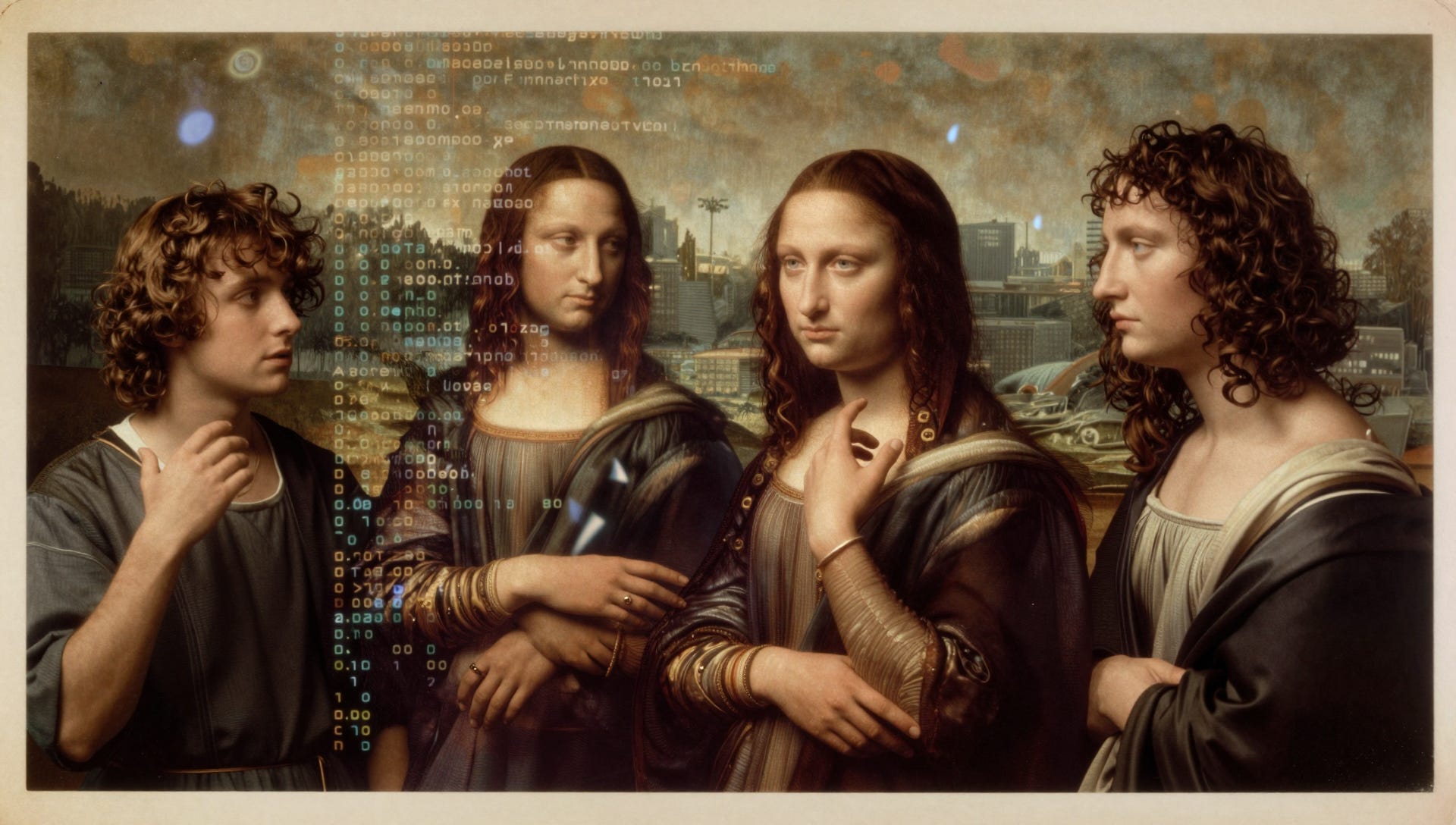
In attempting to grasp contemporary nihilism, perhaps the most precise interpretation is that of a subtle erosion, a process that’s gradually hollowed out concepts, stripping them of their substance. To understand this gutting process as a form of late-Bourgeois decadence overlooks how the devaluation of values stems from a material recoding of ourGesellschaftstriebwerk: a digital nihilism, if you will. But since this process has unfolded gradually over the past few decades, we’ve also grown accustomed to the most eerie of all guests; thus, we are not dealing with a tangible break, but rather with a barely perceptible transformation: This is the way the world ends / Not with a bang but with a whimper. Consequently, this response to the horror vacui, the moment of the intangible, can turn out to be highly paradoxical. Because attempting to compensate for the loss of substance involves inflating the void—and giving it an unquestionable form. This inflation, as a form of psychological inflation, remains undetected as long as everyone believes in it. Paradoxically, even as social media surreptitiously drives the Attention Economy logic, it enables the free radical, the MeToo, to entrench itself against the intrusion of reality. And because the soft whimpering can be drowned out by volume, the void can also take on an exhilarating, numbing form. For this semantic amplification (pump up the volume!) inevitably leads into the world of categorical superlatives, into a sphere where everything revolves solely around ultimate justifications. Consequently, people invoke higher powers (the Noble Savage, human rights, Mother Earth Gaia) in an effort to escape post-Modern intellectual impasse. That the goals are honorable in themselves is, in a sense, the gateway to the logic of self-deception that the magician Harry Houdini so wonderfully put into words: For where desire becomes the father of thought, it becomes the mother of illusion. If this is the case, conflict is inevitable. What one vociferously opposes ends up establishing itself behind one’s back. Even the postmodern notion that everything (gender, identity, power relations, etc.) traces back to a performative speech act contains an irresolvable contradiction—indeed, a coincidentia oppositorum. Because, with this twist, an agreement has been reached on the Arbitrary Sign’s face value, it isn’t particularly convincing to attempt to transform this merely alleged identity into essentialism. In this context, the recently adopted concept of ›self-determination‹ stands out as a legal absurdity because it places every contemporary in the position of a Central Bank, a royal child who can compel everyone else (under threat of substantial fines) to believe in his act of self-assertion. Just how absurd this is can be demonstrated by a small, very personal story. Because my father had a pronounced aristocratic streak (which led him into genealogical research), I was confronted during my childhood by a family tree in which Charlemagne resided at the very bottom—with I, Me, Myself, reigning at the very top. Now, by following this logic, I could insist I’m of royal descent and, from this point forward, wish to be gender-neutral and addressed as Your Majesty. And if I were to invoke the »right of every person to dignity and respectful treatment with regard to gender identity«, I could henceforth—based on the prohibition against disclosure set forth in Paragraph 13—take legal action against any fellow citizen who were to express doubt about my royal lineage—or even merely point out that the name ›Burckhardt‹ does, after all, indicate a bourgeois origin. If this small exemplar makes it clear that such a trifle has been elevated to the status of a social program, it’s also evident that we’ve maneuvered ourselves into Absurdistan. That this absurdity has become general law only shows how deeply the most sinister of all guests has plunged us into turmoil.

But how can we escape the allure of nihilism? It’s easier said than done. The fact that people have strayed into a mental labyrinth that leads to a dead end at every fork is powerful evidence that psychological inflation—insofar as it fuels self-assertion—is a far more bearable state of mind than the admission of one’s own powerlessness. And the likelihood that the chorus of the discontented will grow in size and volume is enormous. If the lament over the »big lout« (Heinrich Heine) already marks a low point in political discourse, the arrogance of the morally superior seems to be the prelude to an even deeper fall. It is already clear that even those who, as Anywheres, have so far counted themselves among Globalization’s winners will be affected by the digital upheaval—and will likely respond with growing resentment. From a structural perspective, we will remain under the spell of nihilism as long as we view this uninvited guest as a foreign body. This situation is familiar to us from the history of early Renaissance Florence, where an agitator like Savonarolawho, on one hand, made use of Gutenberg’s printing press, while on the other, terrorized the city’s inhabitants with his child soldiers and the Bonfires the of Vanities—a behavior that Max Horkheimer captured wonderfully with the concept of Erotic Resentment. Accordingly, what we have called Moral Economy is nothing other than the collective denial of this change—namely, that the most uncanny of all guests is and can be none other than the reflection of ourselves. Only when one acknowledges belonging to the species of digital natives—and that this possession has a life-changing, psychogenic quality affecting us as profoundly as the advent of the medieval gear-driven automaton, which blessed humanity with tact, punctuality, and a sense of the symphonic—will one be able to break free from the nihilistic spell. And then it becomes conceivable that there could be such a thing as a digital Renaissance—a new era that (as Jakob Burckhardt so beautifully put it) discovers the World and Humanity.
Translation: Martin Burckhardt and Hopkins Stanley
One only needs to look at Heidegger’s The Essence of Nihilism [see Heidegger, M. – Metaphysics and nihilism: 1. The overcoming of metaphysics; 2. The essence of nihilism (A. Iyer, Trans.), Cambridge, 2022. (Original work composed 1938/39 and 1946–1948)], in which he loses himself not merely in the catacombs of metaphysics but in his own self-created terminology, to be convinced that we’re dealing here with the abysmal nature of metaphysics. Nietzsche himself gave a concise answer to the question: What does nihilism mean?, an answer that implies not only the death of god but also the end of metaphysics: »That the highest values lose their value.« In this sense, he can state that we are dealing not merely with an act of destruction, but with a subversion into irony: »›Nihilism‹ as the ideal of the mind’s supreme power, of the most abundant life, partly destructive, partly ironic.«
The group’s manifesto states: »We do not work at Rheinmetall. Our names are not Elon Musk. We do not force people to mine lithium under horrific conditions. We do not destroy the Earth. We do not trade grain on the stock market. We do not want to kill other people, nor do we willingly accept their deaths for the sake of profit maximization. We even save the snails on the power pole before we set it on fire minutes later.«
»In a world rich in information, the abundance of information signifies a scarcity of something else: a scarcity of what the information consumes. What information consumes is quite obvious: it consumes the attention of its recipients. An abundance of information thus creates a scarcity of attention.« See Simon, H.A. (1969/1971) — Designing Organizations for an Information-Rich World. In: Martin Greenberger: Computers, Communications, and the Public Interest, Baltimore 1971, pp. 41–42.
See Ernest Bornemann: Zur Psychoanalyse des Geldes. Frankfurt 1973. — It may be a historical footnote, but it should be noted that the Society for Consumer Research, founded in 1934, was a Nazi institution. The fact that the public broadcasters, even before the Internet instituted clickbait logic, dedicated themselves to quota at the end of the 1980s (without any need for any need to discuss the consequences), may be taken as evidence that one is not dealing here with a conscious decision, but with a visceral adaptation behavior.
For the origins of money, see Laum, B. – Sacred Money: A Historical Investigation into the Sacred Origin of Money, trans. Hans Dg Hyun, 2023.
I’ve dedicated an entire book to this story, which is only summarized here: See Burckhardt, M. – 68. Die Geschichte einer Kulturrevolution, Berlin 2009.
»Globalization is not something we can hold off or turn off. It is the economic equivalent of a force of nature, like wind or water. We can harness wind to fill a sail. We can use water to generate energy. We can work hard to protect people and property from storms and floods. But there is no point in denying the existence of wind or water, or trying to make them go away. The same is true for globalization.« FromPresident Clinton’s Speech at Vietnam National University.
I’ve devoted an entire booklet to this concept. See Alles und Nichts: Ein Pandämonium digitaler Weltvernichtung, Berlin, 2015 (mit Dirk Höfer).
See Wilde, O. — From De Profundis, in The Letters Of Oscar Wilde, ed. Rupert Hart-Davis, New York, 2000, p. 501.
See Lasch, C. – Culture of Narcissism: American life in an age of diminishing expectations, New York, 1991, p. 40.
Hermann Rauschning, who recorded this snippet of conversation, described the National Socialists’ rise to power as a »revolution of nihilism.« See Rauschning, H. – The Voice of Destruction, New York, 1940, p. 237. »I asked whether that amounted to saying that the Jew must be destroyed. ›No,‹ he replied. ›We should then have to invent him. It is essential to have a tangible enemy, not merely an abstract one.‹«
See my chapter on modern anti-semitism from Über dem Luftmeer: Unbehagen in der Moderne, Berlin, 2023, which we’ve translated on ex nihilo as Perverse Modernity: On Modern Antisemitism and the Invisible Hand, March 05, 2026.
See Burkchardt, M., Stanley, H. - What does it mean to be literate?: A Post-mortem Conversation, Ex nihilo, June 29, 2025.
That a thoroughly subtle thinker like Bruno Latour succumbed to this temptation in his Gifford Lectures—and divided the world into nature-conscious Gaia disciples and world-forgetful computer nerds—indeed, that he didn’t even shy away from applying Carl Schmitt’s distinction between friend and foe—shows just how deep the unease with our culture runs.
See Karl von Amira – Thierstrafen und Thierprocesse. Innsbruck 1891. Also P.E. Evans – The Criminal Prosecution and Punishment of Animals. London/Boston 1906.
C.G. Jung had a keen sense of this: »Individuation, in its psychological sense, is an opus contra naturam, which generates horror vacui in the collective layer and all too easily succumbs to the onslaught of collective psychic forces.« (C.G. Jung – The Archetypes and the Collective Unconscious. In Collected Works Vol. 9.1, Düsseldorf 1995, p. 161).
Related Content
From the Abuse Value

As already laid out in this series exploring Martin’s œuvre, he began his writing career questioning what a computer was, laying out the groundwork of those early thoughts in his first published article titled Digitale Metaphysik. He followed this with
