


This is a lecture Martin presented at the Institute for Cultural Studies at the University of Basel in 2003, a time before social media had seen the light of day, and practices such as shaming and canceling were still unknown, as was copy-pasting. Nevertheless, and this is what makes this text so unique, all of this is anticipated in this text, leading to the assumption that we were dealing with a fundamental shift in our Social Systems: a Sign of Digitalisation, one that Martin was already aware of.
Hopkins Stanley

Ladies and Gentlemen,
God knows what drove you to attend this lecture. Perhaps it was the frivolity of the title. If that’s the case, you cannot say later that you weren’t forewarned. For a moment, I hesitated whether I should have announced a lecture on the »Volatility of the Concept of the Subject« instead of this shimmering title, but I must confess that long ago I vowed to myself to avoid such words as the conception of the subject. And why? Because I cannot see anything self-evident in it, only a counterfeiting operation that isn’t exposed—‚thus, revealed in its own instability—precisely because we participate in it, because we assert reasons where we should be speaking about the unfathomable. Now, when we talk of this or that thing’s volatility, the matter itself has already flown the coop [aufgeflogen]—and so the sparrows chirp down to us from the rooftops that the subject is an illusion, existing only on the basis of an attribution. This, my dear listeners, will have also long been common sense to you. What astonishes me so about this academic convention—no less, incidentally, than that strange bird of the autonomous subject which once irritated me—is the ease with which this can be said: the subject exists only because of an attribution. In a certain respect, this dictum strikes me as a justification for Sociology, which, having detached itself from the subject, now concerns itself only with the subtle differences, namely, the taxonomy of attribution. Thus, because the philosophical problem of the subject is removed from the World, it can be used (like the Zero in mathematics) as a frictionless object offering no resistance.—Certainly: this theoretical subtlety carries little weight compared to the practical advantage this statement brings with it. In its applied form, it could be paraphrased with the old social pun: If your reputation is already ruined, you can live shamelessly. If that the what I am [was ich bin] is just a kind of social costume, then I’m free to put on any other costume I like, to be ManWomanHip or whatever1…which turns volatility into pure voluntarism...what’s nowadays called Identity Politics. Now, for my part, I wouldn’t doubt this sentence’s meaning to come up with some kind of substantialism. Au contraire: what I have in mind is to take this sentence as it stands simply. When talking about attribution, we are saying the subject is a being that appears in the context of Writing—and consequently is to be read as a letter. Seen this light, the question that Bourdieu would have posed, namely about the nature of attribution, is a subordinate one; firstly, we must be clear about which writing is actually being used. And secondly: whether the person writing is in fact the author of what he writes—indeed whether it is even legitimate to claim to be a Master of Writing. Perhaps this objection seems casuistic—but for me it’s the starting point of my inquiry. In fact, I’m now convinced that our mastery in this domain is merely apparent. And not just because writer’s craft teaches us the art of failure, but rather because Writing itself harbors a fundamental lie of self-deception, a proton pseudos. To quickly demonstrate this in a thorough way, let’s look at a kind of $1000 question. What, if I were to ask you, is the meaning of this Sign: let’s say a capital A? And if we turn it upside down? Then we see the Sign’s meaning before it was forced into the alphabetic Typenrad. No longer the A, but the Alphabestie, the Ox in the Yoke.
I’m by no means interested in tripping you up in any ignorance. I was in my mid-thirties when I grasped that the written Signs didn’t fall from heaven—but have an animal, pictorial history—and that this history, even when it’s split off, pulsates in underground form, as the Unconscious, in Writing. Western Natural Philosophy, the Logos of the philosophers, and the logic of Aristotle—all this is based on the A-Logic of the upside-down, forgotten bull. But this makes Writing itself a collective illusion: the exact counterpart of what the Money illusion is for our exchange relations. Seen this light, the mega-subject of our Writing is also based on an attribution: namely, the notion that the Signs are pure and heavenly, but above all: not contaminated by earthly transience. To reiterate, this is an actual metaphysical imposition—and so I would venture the claim that wherever we operate in the paradigm of Writing, we appear equally as volatile and abyssal creatures, as Angels, Ladies, Flight Attendants [Flugbegleiter]. If this is the case, then you’ll understand how such a frivolously launched attribution logic seems suspicious to me, since I fundamentally assume that we have a metaphysical problem on our hands here.

Now, after this long preamble, let’s finally turn to the abyssal hero of the lecture, to what we call the Subject. In the conventional sense, if we had to establish the birth hour of this gentleman, we would quickly agree on the Renaissance. In images from this period, figures appear who seem to be our equals, and because of this, our Sunday preachers never tire of praising the humanists as our closest relatives and equals. This period presentation of a human-experiment strikes me as an exemplification of the claim that the subject exists not as such, but on the basis of an attribution. Quickly told, the author of this experiment is Filippo Brunelleschi, the »inventor« (think of relativizing quotation marks here) of Central Perspective. The person to whom he assigns his lesson is a Florentine marquetry painter, known to everyone as the Fat Man. If you consider what is at stake here (namely, the substance of what we consider to be our very essence), both the Fat Man and the fact that he is an inlay artist, thus a craftsman-artist who designs the interiors of tables and the like—with tabernacles, treasure chests, but also with the most exquisite and intricate inlays—are well chosen. And just what will happen to this nice guy? It starts with a bit of irritation. Someone greets him, but with a name that isn’t his. Well, that can happen, but what’s even weirder is that when he gets home that evening, his wife also calls him by that name and refuses to open the door to their own apartment, saying he isn’t her husband. He goes on a rampage—which in turn brings a guard onto the scene. The guard also addresses him by a strange name and tries to reason with him—but our fat man is so distraught by the events that he cannot calm down. He is taken to the guard station and locked up for the night.. He’s led to the guardhouse—and booked for a night. In the cell, in turn, a fellow prisoner awaits him who seems to know him as another; the same applies to the judge before whom he’s brought. And very gradually our Fat One begins to doubt not only the world but himself, which, as we can easily conclude, was the purpose of the exercise.

But now, dear Mr. Burckhardt, some might counter that you yourself have provided the keys to understanding the story, revealing the subject as an act of attribution. Certainly, but if you recall, I did NOT question the sentence as such, but rather the fact that one evades the fact that one ignores the inherent problem of Writing. But what kind of writing does Brunelleschi use here?What code is required for this human experiment to succeed, assuming it will? If you analyze the deception’s prerequisites, you will notice that this attempt only succeeds because a) there is a central perspective arrangement (which, incidentally, is the logic of paranoia), and b) because Brunelleschi was able to get his fellow players to agree to follow the logic of this setup. But this means that what the subject is isn’t just a written character, but a collective matter, and moreover, one that’s socially acceptable. If it were otherwise, Brunelleschi would have had difficulty finding understanding collaborators. Thus, when Brunelleschi succeeds in making his Fat Man understand the subject is an attribution, it’s because his fellow players, all in a psychological sense, are already paying homage to this new project of Central Perspective. This observation alone is quite remarkable, since it makes clear that Central Perspective is NOT a painting technique, but about a form of social organization, or as I would say: a collective educational measure.
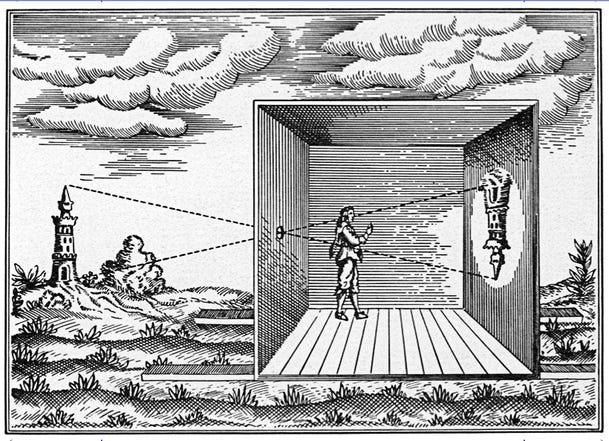
Of course, this raises a fundamental contradiction. Against this backdrop, the subject appears anything but autonomous; instead, it’s part of a social project expressed solely through portraiture and Central Perspective. It’s only because Central Perspective is a form of social organization that Brunelleschi can count on his fellow players. But how can the social project that underpins it be more precisely specified? And what is the message that the co-players send with their readiness to participate in the show trial against the Fat One? The simplest answer would be: to signal the Fat Man that his worldview, this self-assured, complacent certainty, is hopelessly obsolete. You may believe, so the unspoken message goes, that the value of a thing lies within itself; you may believe that you remain one and the same, but we know that the value of a thing, like the identity of a person, is based on a social agreement—and to prove this to you, they are teaching you this lesson. And by demonstrating this lesson to you, it proves that we are privy to the mutability of human nature. While you cling to the ideology of substance, we understand that the stuff human beings are made of is a metaphor and therefore mutable. We can—and that is the message (or the threat, depending on your point of view)—we can also be different. In fact, Brunelleschi’s human experiment takes us to the core of what Humanism and the Renaissance considered their most essential characteristic—and which has little to do with the subsequent idealizations to which we have become so accustomed. It is no coincidence that Pico della Mirandola, who can be seen as the philosophical ghostwriter of Brunelleschi’s experiment, equates the dignity of man with his mutability:
Man is a chameleon.
To characterize this versatility, which forms the conceptual basis of the subject, the Renaissance chose a term so revealing that it should NOT go unmentioned here: virtù. The virtù refers to the abstract potential—the scope of action available to the Renaissance man—what we still refer to today as virtual (the classic philosophical term), even though the Computer World is increasingly absorbing it. However, the word’s meaning becomes more interesting when considering that virtù contrasts with the medieval virtutes, that is, virtues. The usurpation of the term in this way isn’t accidental by any stretch of the imagination: instead, it’s an expression of an intellectual conflict between virtue that’s tied to a substance (a specific type of action) and virtue that’s equated with the available scope of possibilities (and thus, strictly speaking, demoralized). Here, if you will, the powerful image of the Renaissance man emerges, oscillating between cynicism and joie de vivre. Now, as Brunelleschi’s experiment teaches us, virtù is by no means the same as absolute freedom—for above all else stands the Law of Central Perspective, the logic that unites all players. It has become all too easy to forget this law. Nevertheless, it is a general obligation: a kind of omnibus that must be boarded if you want to assert your subject pretension. If the fat marquetry painter falls victim to this law, it’s because the nature of his subject pretension is no longer accepted as an entrée ticket here. But this brings us finally to the Writing used when attributing a subject. Undoubtedly, this is no longer a God-given, sacred Writing, but a human code—one which, of course, has to externally legitimate itself eagerly absorbed transcendental energies. To characterize this Writing, I would speak of the Code of Representation. – This code encompasses all areas of life: Politics, Money, Mathematics, Philosophy, Social Forms of Organization, Jurisdiction – moreover, its origins go far back into Medieval Society. It would go beyond the scope of this lecture to attempt to recount the history of Representation. So I will content myself here with this assertion, which points to the remarkable shift in meaning that repraesentatio has undergone. While repraesentatio was understood in the 12th century as the »register of saved souls in the Book of Life in Heaven«, this heavenly book undergoes a slow degeneration: the happy few come to be conceived as belonging to this world, and ultimately, in Thomas Hobbes’ philosophy, only the Logic of Representation remains. – Of course, in this context, describing this intellectual inner space in detail doesn’t really matter. I am more concerned with the question of whether culture operates at this level of Writing. Basically, Brunelleschi’s attempt alone should give us cause for doubt: it can be assumed that the collaborators took pleasure in confusing the Fat Man while otherwise revelling in their own freedom and superiority. It most likely did not occur to them that the apotheosis of this freedom must be paid for by the individual placing his newly won freedom at the service of a Räderwerk-like process, indeed, that it is only this subordination that guarantees the subject’s freedom. Now, this is anything but an abstract consideration; Au contraire, it is the conditio sine qua non of this experiment. Although I am free to choose this or that role, I am nevertheless compelled to act in concert with everyone else, to be a small cog in the wheel. If just one fellow player, moved by compassion, had been tempted to improvise or otherwise deviate from the prescribed course, the experiment would necessarily have failed. Here, a new sovereign raises its head, and it becomes clear that the Renaissance Man, the archetype of the autonomous subject, is still sub-iectus, that is, the subjugated—only that he’s no longer subject to the supreme God, but to a worldly order: the Räderwerk, the Central Perspective, the Code of Representation.

One of the great peculiarities of our culture, one that’s as strange as our blindness to the image of the Ox in Aleph, is how we don’t think about the Writing used to make attributions. And this blindness isn’t limited just to individuals; it’s true for society as a whole. Whatever the corporate body, when you ask about its origins, you always encounter not the logic of attribution but a myth of origin. An exemplar: if we make Descartes the founder of Modern Philosophy (and also of the Modern Subject), we overlook the fact that his thinking’s central driving force, the Wheelwork Automaton, is a product of the 13th century—that Descartes, strictly speaking, is four centuries late. – Without a doubt, there seems to be something like a profound, almost unconscious interest in the origin myth at work here. Seen in this light, we might well be inclined to agree with Schlegel’s dictum that the historian is a backward-looking prophet. If we understand this historiography as retroactive prophecy, then the dictum that the subject is an attribution is relieved-out as wishful thinking. We wish it to be so, and we wish it to be us who perform this attribution—freely and at our own discretion.2 But this describes the mechanism underlying our errors: that we start not from Writing, but from the writer. This brings us to logic, even though logic is a misunderstood Alphabet; it brings us to Descartes, even though Descartes is a misunderstood mechanism; and it brings us, generally speaking, to the calamity of metaphysical chimeras creeping into our everyday reasoning, these odd birds for which, when viewed in the light of day, have no actually justification. (Try telling a lawyer that a limited liability company is the earthly heir to the body of Christ... He will smile at you in disbelief, but that won’t stop him from giving you a five-minute lecture on the legal principle of good faith...)
But who actually says that questions of Identity are about seeing things in the right light? Isn’t it much more likely that here we’re dealing with constitutive misunderstandings and overlapping mistakes, what used to be called the general context of delusion? Perhaps—at least that is the conviction I have increasingly come to—it’s the failure to recognize the subject’s linguistic character that is the very condition enabling the subject to understand itself as such. (Perhaps you can only become a logician if you’ve completely repressed the memory of the Alphabeast.) In this sense, the subject illusion would be the exact equivalent of what the money illusion is for our exchange relationships. We all know, more or less, that the object to which most of our efforts are directed doesn’t really exist, that behind the Sign representing a value, there’s no real substance value anymore. And yet money means to us, insofar as we all believe in it, hardness itself – it means everything to us. And because we all believe in it, the illusion becomes Reality. In this sense, the subject illusion would be the exact equivalent of what the money illusion is for our exchange relationships. We all know, more or less, that the object to which most of our efforts are directed doesn’t really exist, that behind the Sign representing a value, there’s no real substance value anymore. And yet, insofar as we all believe in it, money means everything to us. And because we all believe in it, the illusion becomes Reality. From a cultural perspective, this is a remarkable process: here, a society of people (who do not know one another and cannot know one another) forms around a shared illusion. Quasi out of nowhere arises the improbability par excellence: a free-floating construction.
Against this backdrop, I could simply turn my disrespectful remark about the oddballs of metaphysics around: I could fall into a kind of admiration, a kind of heavenly awe of these angelic beings. Then, when reverence has given way to a sober view, we might come to the realization that the general context of delusion so abhorred by the Critical School is, in fact, a social necessity—that we need this form of illusion production to communicate with one another. What would happen if this community of belief were to crack, if a significant number of believers were to leave the communitas? What would happen, as an exemplar, if I were to start circulating a Burckhardt instead of a euro…this children’s question merely highlights the precariousness of our existence in modern society. For the money illusion, this prototype of the general context of delusion is, as an aerial structure, constantly in danger of crash-landing—only that one, like a comic figure, will only fall when one casts a glance at one’s own feet.
That, I believe, is precisely the historical situation in which we find ourselves. Like our comic characters, we glance down at our feet and see that where there should be a foundation (and our predecessors claimed there was), there is nothing but a gaping abyss. I am your flight attendant, madam...In any case, the abstruse logic of the cartoon seems to me much more appropriate than the pathos with which Foucault ends his Order of Things: Man is dead—and his face will be lost like a trace in the sand. For man has not died in a heroic way, but in the most thorough way imaginable: death by ridicule, by continuous involuntary self-irony. This explains why the rhetoric of man still circulates, and even more, why it still exerts considerable appeal in the sense of a ridiculous but hollow ideal. Nevertheless, it would be misleading to measure the project of man by its pretender. The deepest reason for the demise of the subject is not the folly of its followers, but rather that the Project of representation has come to an end. Seen in this light, Humanism á la Benetton is a very accurate indicator, since only what is already finished can be exploited. It is not humanity, but the dead shell of humanity being brought to market here. If I set about issuing you a death certificate here, it’s quite natural that you’d like to have a date and a cause of death noted. Unfortunately, I must disappoint you—and not only because human beings are primarily symbolic entities. The hollowing-out of the subject, its gradual transformation into a ridiculous person, represents a creeping process, a chronic illness in which declarations of death and prayers for recovery balance each other out. Nevertheless, just for rough orientation, I want to show you a few markers that seem to me essential for the decline of man. Its beginnings date back to the 18th century, to the mass society that was simultaneously electrified and sensitized. It begins with a distrust of the idea of Representation. Where, formerly, under the laws of Central Perspective, a representative could act on behalf of a larger quantity or group, individuals now assert their right to immediacy. For Rousseau, Representation is nothing less than a diabolical power that deprives the individual of his voice, his freedom, and his capacity for decision-making. By the end of the 18th century, this contradiction had grown into a great rumbling— it is increasingly about the desire to banish the Image’s rulers—the king and queen—from the Image itself. It’s no coincidence that the king falls victim to the first serial machine: the Guillotine. It’s not only the king, but also the executioner, falling victim to the Guillotine. And as perpetrator and victim become invisible, the idea of the deed disappears. Under the Guillotine’s blade, we encounter for the first time the modern paradigm: The Deed without the Perpetrator, the serial subject, the fact that individual death becomes invisible to the degree that the manner of death digitalises. – Where a subject once reigned, abstract sovereignty now reigns: the Machine. Now—this statement need not be taken theoretically; it can just as easily be taken figuratively. If you imagine the camera obscura of Representation, you’ll always see a human in the interior of the chamber, in our case, it’s the experimental director Brunelleschi. Where the camera mechanizes, there’s no one anymore, only an empty space. In fact, the Project of Representation is philosophically finished with this moment. While it is still a serious, satisfactory opponent for the pre-revolutionary Rousseau, Schelling sees it as nothing more than an aesthetic imitation, a tracing technique. The Romantic genius isn’t supposed to reproduce the World, but rather, in a genius-genetic way, create it from within himself. If these markers are already clear evidence of a lethal condition, strengthened by the aesthetic detachment of Painting too from the Logic of Central Perspective, then the final death blow comes in Mathematics, the discipline that—averse to all semantics—lets only pure forms count. George Boole, who in the mid-19th century designed the thinking machine that drives our contemporary computers, speaks explicitly of the »death of the representative. « The Representative: that was, in 14th century mathematics, this quantity which was able to resolve proportional ratios of A:B = C:D (the principle of quadruplication) into a third quantity. In this form of mathematical triangulation, you can recognize the projective model of Central Perspective.
With Boole, however, zero and one, the king numbers of mathematics (as Schrödinger called them), are undergoing a new revolution—because algebra no longer refers to abstract quantities, but is beginning to calculate with qualities, apples and pears, in a multidimensional space. But when you stop counting on a certain fact, it means that it will no longer occur—or that, if it does occur, you’ll no longer be able to decipher it. I hope you will forgive me for this whirlwind tour through intellectual history. Ultimately, the situation is as simple as the king’s death by guillotine. Where there used to be a Triebwerk, there is now a Computer. And where power spells out the language of Representation, we chant the language of Simulation.

Now, we must not forget that the human being (or, to be precise: the representative) is a symbolic entity, not a being of flesh and blood. Consequently, his death is not a fact that becomes evident naturally through a process of decay, but only through an intellectual, painful process of understanding (painful because it requires culture to consent to its own decapitation). Insofar, the death of the symbol is by no means synonymous with its disappearance, but goes—paradoxically—hand in hand with the assertion of its never-ending vitality. Consequently, efforts are made to reanimate the corpse and, armed with media technology, put it on display. This form of self-assertion is all the easier because the images of the subject have, over the longue durée, assumed a socially binding, seemingly self-evident skill. As surrogates for Identity and uniformed subjects, they are frivolous: ready mades. And because they can be put into service so easily and frivolously, thus simulated, fascism has been able to stage them masterfully: it simulates the Power of Representation so that it now openly appears as a State Religion, as the Aesthetics of Power. The techniques used in this process no longer have anything in common with the Logic of Central Perspective—they’re foreshadowing what was later summarized under the rubric of simulation technology (radio and television).—Permit me here a small side remark: The slogan of Totalitarianism could lead to the conclusion that National Socialism was the epitome of a Central Perspective State. This isn’t true. If you read Wolfgang Sofsky’s Order of Terror, you’ll discover that the National Socialist power structure has more to do with what we now call lean management and »personal responsibility.« And precisely because the heart of the National Socialist enterprise beats at every single workplace, this is dispersed, the collective facelessness beneath the portrait of the Führer can run riot all the more unrestrainedly.—In Fascism, the image of the individual has long since ceased to have any positive, binding meaning and functions primarily as a defensive spell, an antidote to the imposition of a modern, Post-representative conception of the subject. Seen in this light, it is anything but coincidental that the Fascist battery was fed by the historical catastrophe of symbolic horror, the volatility of money in times of hyperinflation. Fascism is a resuscitation technique, a defensive spell, the politics of the wannabe. What was once a promise turns into the perversion of defiant self-assertion. For this reason, the wannabe cannot find self-satisfaction in the Image: for what he would see here would be the grimace of ressentiment. Consequently, the only thing giving the Image its aura is mass reproduction. The other side of the Führer portrait is facelessness (Excursus Hobbes, Frontispiece). In this sense, the individual’s close-up finds its counterpart in the mass formation, the geometry of bodies (and in what the images do not show: the facelessness of the mass grave). This explains the stiffness, the thoroughly necrophilic quality of the mass arrangements, which should hardly be called tableaux vivants, but more aptly tableaux mouriants.
Just as we retrospectively view the 14th century as the end of the Middle Ages, as a transitional time of crisis, the 20th century will be remembered as the century of the representational crisis, of anomie. One date is of particular significance here, especially because the death of Representation became a mass cultural event, an event that allowed no return to the status quo ante: the year 1968. For my part, I would say that the year 1968, as a pop and mass event, repeats what was meant by the decapitation of the king. If there is an enemy, it is the order of centralized perspective, the representative system of rule. To avoid the seduction—or the imposition—of wanting to wring a profound message from the moment’s graffiti, I would like to draw your attention to those revolutionary transformations that all date back to 1968—but have been overshadowed by the more television-friendly images of young, energetic street fighters. The revolution doesn’t occur only on the streets but also within the system itself: it’s system-immanent. Thus: 1968 is the year when brain death is defined and issued as the date of death (which, since I’ve already confronted you several times with the Guillotine’s metaphorics, can be grasped as a form of physical decapitation).

But it was not only medicine, thus soma, that underwent a revolution in 1968, but also the sema, the Sign that holds Capitalist societies together. In 1968, France launched an attack on gold, resulting in the monetary world order, nolens volens, being surrendered to the law of free-floating exchange rates. Strictly speaking, this is a declaration of capitulation by the Nation State, because now the anonymous, placeless money markets are taking control of Capital (once again, a decapitation).—If these two revolutions already signified a profound change in the symbolic body, the third split articulates the deepest schism of the present: namely, that the World of Things and the World of Signs are now completely diverging (or, in the case of the monetary Sign, that we’re moving into free floating). But it was not only medicine, or soma, that underwent a revolution in 1968, but also sema, the sign that holds capitalist societies together. The occasion may not sound particularly earth-shattering, but its consequences certainly were: it’s the lawsuit against IBM. The background of this lawsuit was the computer manufacturer’s attempt to retain the software that ran on IBM personal computers — and, equally well, on much cheaper computer clones — for itself. The interest was unambiguous: the company’s attempt to maintain its position as a monopolist, as a central-perspectival, monolithic ordering machine. However, this bastion was razed, and so the lawsuit’s result (which was discontinued, incidentally) was that a free-software trade could develop. Software, however, unlike naturally occurring resources, no longer knows any material scarcity. Its law was formulated by Boole in the 19th century: x = xn. The death formula of Representation.
Now, I think you are well aware of the consequences of all these revolutions, because they are nothing other than what drives our reality. If we attempted to find a common denominator for this quadrivium of revolutions permeating the social sphere, from the body to money, from political theory to organizational form, two points could be noted: first (this would be the side facing the past), we’re dealing with an annihilation of Representation. This annihilation runs much deeper than a mere rhetorical attack could: it targets the central-perspectival bodies in their constitution. No government in the world can ignore the unleashed money markets; no organization form can assert itself as a monolith; and no subject can think of itself as unscathed, intact and unique.
Let us turn to the second common denominator, which constitutes the Revolution’s future-oriented dimension and is somewhat more challenging to describe.—Nevertheless, let me attempt it. The hallmark of change is that what was formally regulated by ordre de Mufti is now taken care of by the Market. But who is this Market? The attempt to posit a kind of subject here, thus a kind of International Association of all consumers, seems absurd to me. Nevertheless, it would be equally absurd to deny that the dictum of this International Association character of law.—Well, the solution is probably in turning away from the individual’s self-image—and focusing on the message being sent out. If the political demand of Representation was one man one vote, then the slogan of Simulation is: My belly belongs to me! To put it more elegantly, we could also speak of libido economics. If you relate this term to de-materialized Capital, it immediately makes sense—just as you can bring the term into harmony with the so-called sexual revolution, thus aligning it with the actual concern of the 68ers. The third instance too, the free-floating software, can, as a desiring wish-machine, be brought into agreement with this term. Because we’re venturing into murky territory here, it’s a bit less straightforward to reconcile the definition of brain death with the liberation of the libido economy. However—the emphasis on the cerebral as the only vital instance—already points the direction, that direction which the students pointed out when they chanted:
L’imagination au pouvoir.
What this definition entails is nothing more than the modularization of the body, accompanied by simultaneous aestheticization. When the body is transformed into a spare parts warehouse, or an appendix to my enjoyment, it becomes a full-body prosthesis whose sole purpose is to satisfy cerebral function, of the phantasm. If this is no longer given, the body falls to the collective and is surrendered to the collective’s sphere of circulation. (Perhaps you will allow me a small aside here. While reading the 1968 Sponti-documents, I came across a somewhat strange demand that nevertheless strikes me – in a political sense – as interesting: it concerns the demand for sexual autonomy—that the with whom, when, where, and how of sexual expression should be up to the individual concerned—however, what grows in the womb – the child – should be a matter for society, and thus collective property.
Now, I gladly confess that if you study the accounts of that period, you’ll hardly encounter those thoughts and interpretations that I’m presenting to you here. This isn’t particularly surprising. When I said earlier that a symbol doesn’t die but can be reactivated, reanimated, and revived at any time, I’ve, for the sake of logic, massively oversimplified the matter considerably. In fact, the dialectic is a bit more unfathomable than that. As a rule, the death of a symbol is a precondition for its aesthetic enjoyment. Only when the king, as the ritual number, has been discharged can he truly behave in a royal manner. Only when the danger of paying for the insurrection with one’s own head has been averted does the aesthetics of revolution unfold, allowing every idiot to act like a revolutionary. The dead symbol demands no more sacrifice; anyone can help themselves as they please. At this point, we encounter the physiognomy of what I’ve called libido economy. For the sake of simplicity, I’d like to call this candidate the previously mentioned wannabe. If the wannabe is primarily concerned with breaking free from his shackles, then, from a cultural perspective, he isn’t nearly as progressive as he thinks he is. The complete decapitation of the establishment does not mean that artists now turn their attention to the challenges of the present—Au contraire— How much easier it is to draw on the existing repertoire! And so begins the era of wannabe painters who pay homage to their phantasms, the wannabe, in a wannabe gallery. The era of pop, of anything goes, begins.
However, as these roles become increasingly socially acceptable, we encounter an inescapable hollowing out and gutting. Because the Identity costumes that people can slip on (like putting on a printed T-shirt) lack substance as closely as they reflect and reinforce Narcissism. They’re as threadbare as National Socialism’s political theology. This is where the media aggregates that characterize our society come into play. Because they’re only capable of enriching what is lacking in substance with mass. If I do not believe in my own image, audience feedback allows me to ascribe it a reality, a kind of intrinsic value. If I myself cannot believe in my own image, the audience’s feedback permits me to assign my image a reality of its own, thus a kind of substantial value. It is no longer the image itself, but mass consumption that assigns meaning. Strictly speaking, this is a fascist strategy (fascies, as you know, is the bundle, the network). The transmissive context of so-called Media Democracy, even if it’s a thoroughly benign variant, suffers from the same dilemma that characterized the wannabe architect, Hitler. Here, as there, the masses act as an amplifier and meaning surrogate, whose sole function is to avoid acknowledging the Image’s demise.
Admittedly, the amplifier no longer functions as it did in those days. In just over a generation of television consumers, the classic roles have been exhausted, and Representation’s repertoire of narrative forms has been filmed to death. The abusive use of the medium, its conscription as a representing Machine, has exhausted itself—or, in inverted form, flipped into the negative: increasingly functioning as the authority that dismantles the Laws of Representation, tearing down the Politician’s veil, and the like. On the other hand: We may still pay homage to the Laws of Representation on our screens, but our amplifier Machines (like free-floating Global Capital) have long since begun following new laws: what I would like to call the Law of Simulation. Here, a strange phenomenon of schizo-logic relieves itself out: what shouldn’t come to the surface develops subcutaneously. Insofar as the concept of the screen isn’t entirely inappropriate—after all, it largely shields us from reality that doesn’t correspond to our imago.
Nothing is more difficult than surrendering a symbol, nothing more astonishing than the fervor with which people cling to doomed figures of thought – leading to the occurrence of astonishing hybrid forms! Even if humanity’s project has lost credibility and entertainment value, the sphere mourning the demise and desecration of the symbol remains a worthwhile commercium. Man, if you will, is supposed to erect himself on his own desecration.— Now, according to the laws of Libido Economics, this isn’t a moral question but primarily an economic one. Consequently, it’s not at all surprising that a market for the desecrated and abused develops—and, beyond that, a taxonomy of desecration, which I would like to call, in a parody of a Marxian concept, abuse value. You had a particularly bizarre specimen of this type of seller right on your doorstep: Dössinger/Wilkomirski, the would-be victim.3—Now, as in the case of Brunelleschi’s human experiment, such a figure is of social rather than individual psychological interest. Making the question not what Wilkomirski was thinking, but what we were thinking when we chose Wilkomirski as representative of our desecration. The diagnosis is simple: We, who don’t want to admit that humanity is dead, seek the catastrophe’s survivor, the one who assures us that humanity survives within us. All the more embarrassing: that this, too, is only a fiction, that the human project has slipped into a purely blank projection.—In the light of the Libido Economy’s backdrop, the Wilkomirski project seems extremely interesting to me. As you may know, Bruno Dössinger was prosecuted. But what could he actually have been accused of? That he was a plagiarist? In vain they tried, but no, the main charge brought against Dössinger/Wilkomirski was unfair competition. How can we understand this? Translating it back into Swiss legalese, it simply means that Dössinger (and with him Suhrkamp-Verlag) fraudulently obtained Abuse value from the simulation of a childhood that never existed on the marketplace of concentration camp survivors; gaining an undue advantage. But where? On the marketplace of the abused and violated, the nameless...
What is the desire we satisfy by reading Wilkomirski’s book? Undoubtedly, it involves a process of identification. We all, that’s the message of the Wilkomirski project, seem to feel ourselves as virtual victims. You may find such a sweeping blanket claim audacious, but it is remarkable that this form of victim rhetoric has already encompassed so many spheres. When, for instance, a top manager at the Davos Economic Summit claims that everyone is a victim of space and time, we should note that if even the leaders of industrialized nations are attuning themselves to victim status, then there seems to be no one left who isn’t a victim. If, as psychoanalysis has always done, we ask who benefits from this slogan, the answer is: if we claim to be victims, it’s because we want to hold on to our concept of the subject, or more precisely, to our subjective illusion. In terms of individual psychology, you could speak of an Identity Crisis, but, for my part—to do justice to this shift’s nature—I would speak of a cultural rifting.
In fact, the subject problem is only symptomatic of our intellectual continent’s deeper transformation. Drawing on history once more, I see today’s society at exactly the same breaking point as the late Middle Ages—which had the tools of representation, mechanical clocks, usury, and the like at its disposal, but was unable to harmonize this reality with its self-image.—If you want to see this yourself: read what the scholastics wrote about the Theory of Money4. You will find scholarly treatises on the fair price (wishfully thinking—just as our ethics commissions do today), but nothing corresponding to the time’s driving forces [Treibkrätfen] of the time. In fact it’s infinitely difficult to prescribe a new writing system to an entire society—all the more so as its foundations of thinking themselves rest in darkness.
The question would be: what would a remake of Brunelleschi’s experiment look like today? First of all, like Brunelleschi, we’d have to find a victim. Just as the Fat Man is the conceptual incarnation of substance, thus a relic of the Medieval intellectual continent, it would make sense for us to choose someone whose image is intact, one of the happy few who circulate on our screens. For a change, let’s agree on someone thin, like Thomas Gottschalk, for example, cheerful, Haribo-munching, the eternal child. Let’s also assume that we’ve gained access to his Internet connection. Now there wouldn’t really be much to do.
We’d log into various mailing lists under false pretenses to develop a particular virtual characteristic. Infamously, as befits such a human experiment, let’s claim that our skinny guy belongs to the strange society of coprophiliacs, the shit-eaters—and to attribute such a parallel existence to him secretly under the table, we would »photoshop« his head where another coprophile is going about his murky business and post these photos and videos on the internet… To add the final seasoning, we’d attribute financial irregularities, leaks, and the like to him. Now there wouldn’t be much left to do. We’d slip a little hint to a fleetingly known, career-hungry journalist (and, to be on the safe side, also arm a competitor with this information). At some point, after they had picked up the trail, we would send one of them the web address where they could see the scandal with their own eyes – and then we’d just have to leave the matter to the public’s appetite, that particular variety of coprophilia known to them as yellow press.
Now—I don’t think this kind of human experiment is too far-fetched. In fact, it only requires a walk to the nearest kiosk to get an idea of what I mean. But what lesson would we want to teach our thin man? Perhaps that he is not responsible for his image, but rather it’s the context, the feedback system in which his image circulates. Or, shirt sleeves rolled up: If you think you are responsible for your image, you’re mistaken. Because you don’t even exist; you’re only a feedback phenomenon, a mouthpiece, an invention of your audience. And just to show you how fleeting the construction of the subject is, we’ve provided your spotless image with a small stain...so that everything that distinguishes you will now work to your disadvantage. This makes our lesson identical to that which Alfred Hitchcock once demonstrated to his favorite actor, James Stewart. To make it clear to him that the actor’s inner mood is by no means conveyed to the outside world unfiltered, he edited the close-up of a smiling Stewart with a smiling child, and then with the image of a woman in a very short skirt – whereby one and the same smile radiated different meaning, one as heartfelt and sympathetic, the other as lustful.
Well, you remember that I wasn’t as concerned with this part of subject attribution as I was with its Writing. In fact, I think this is where the real transformation lies: that we no longer chant the Code of Representation, but rather the Code of Simulation. But what does that mean? If, in the Central Perspective setting, something became an by the painter positioning it in front of himself, thus adopting a point of view that fixes the frame and its vanishing point – then the contemporary act of objectification consists of my digitizing the object in question. Now, digitalisation can—as something also intentioned by »Me«—can mean many things. The spectrum ranges from digital deconstruction (what’s commonly referred to as analog-to-digital conversion) to entering a digitally monitored space—or the compulsion to identify yourself upon entering such a space with an access code. But this process can just as easily be completed without using technical means, in a purely metaphorical sense. It is sufficient for someone to treat me as if I were a digital object to turn me into one. In fact, all these digitalisation acts were part of my conspiracy: hacking his access code, the stolen identity, the doctored photograph—and, last but not least, the moral digitalisation: that I treated my Thin Man as if he were identical with his image, a public figure, a Sign.
Once this logic’s validity has been agreed upon, it’s only consistent to hang the subject’s conception onto the control of this digitalisation process. However, we encounter a peculiarity here, because we must include a new specimen: the machine subject. When a surveillance camera, a sensor (or any form of programmed intelligence) monitors a space—and responds to a particular behavior with certain consequences, it’s only logical to apply the subject concept here as well. You could counter that the Machine is nothing more than the programmer’s outsourced intelligence—and undoubtedly you’d be right. Nevertheless, I’d like to stick with my formulation of the machine subject, simply because the machine (the Guillotine) allows a decision (for which no one wants to bear personal responsibility) to be delegated. The decision is discharged, only no one is responsible for the act. If you examine my experimental description, you’ll easily rediscover this logic: it is the moment when I armed the journalistic system without appearing myself. Undoubtedly, this was a morally reprehensible gesture, but I fear that much of contemporary communication consists of such gestures—that we continuously feed things into the system without taking responsibility for our acts of its feeding. The Deed without the Perpetrator is system-immanent as the push of a button, nothing more. Nothing personal. And because we no longer take the push of a button personally, it’s mutated into ideological quantitative forces; we speak of the constraints of the market or globalization as if these forces were something other than ourselves. Perhaps here lies the greatest challenge, for we must increasingly deal with quantities and forces no longer identifiable with this or that human being, indeed, no longer even possessing human form. A subjectivity that is as phantastic as it is phantasmal has stepped into the space between people, a headless mega-sovereign whose annihilating, anti-humanistic power consists in its being thought of as an autonomous, abstract rationality. This power puts Man on trial simply because we are human, that is: limited. Finite.
I fear this annihilating power will remain in power as long as we take it as something Other rather than a personal concern. And yet, the point is learning to live with the fleeting ephemerality of Signs—so that I can grasp them not as a curse and global conspiracy, but as a vehicle of flight and personal concerns.5 This may be an unreasonable imposition, as its price involves nothing less than abandoning the past in the prohibition of invoking the Laws of Representation. On the other hand, it’s also something wonderfully exciting, a world that’s still completely blank and unwritten. Which is why I would like to read my title not as frivolity, but in truth as an invitation: I am your flight attendant, madam!
A word play reflectively mocking Identity Politics’ trendy options—Woman, Man, whatever costume gets you through the night...
Even when it comes to bringing the arcane secrets of Writing to light, this is repeated. One of the great philosophical works I have read is Foucault’s The Order of Things, yet this book, for all its greatness, is also a notable aberration. When I began to study the code of representation, the question of why Foucault begins the history of representation in the 17th century, why he begins the Logic of the Mirror with an image from the 17th century, even though the mirror already existed in the 16th century, was a source of endless surprise. Why does Foucault begin the history of representation in the 17th century? Why does he invoke the Logic of the Mirror with an image from the 17th century, even though the mirror had already appeared in the early 15th century, and the concept of repraesentatio was already preoccupying 12th-century scholastics?
Bruno Dössekker, alias Benjamin Wilkomirski, gained notoriety in 1998 when it became clear that his life story as a Holocaust victim was a confabulation.
Nicole Oresme, who wrote “De mutatione monetarum”, a treatise on money degradation, is the outstanding money theorist of the 14th century.
Note the prescience of flight vehicle as an anticipation of a leitmotif Martin will use in Über dem Luftmeer: Unbehagen in der Moderne [Above the Sea of Air: Our discontent with Modernity], Berlin 2023 – the second volume of his Psychology of the Machine series..
Related Content
Alien Logic

The following is the visualization of a lecture Martin gave on May 11, 2021, at Vienna's IWM, where he spent a few months as a fellow in the spring following the publication of the Philosophy of the Machine. Because this lecture is a tour de force pulling together his previous thinking as a prequel to his five-book series, the
